Sunday, February 19, 2012

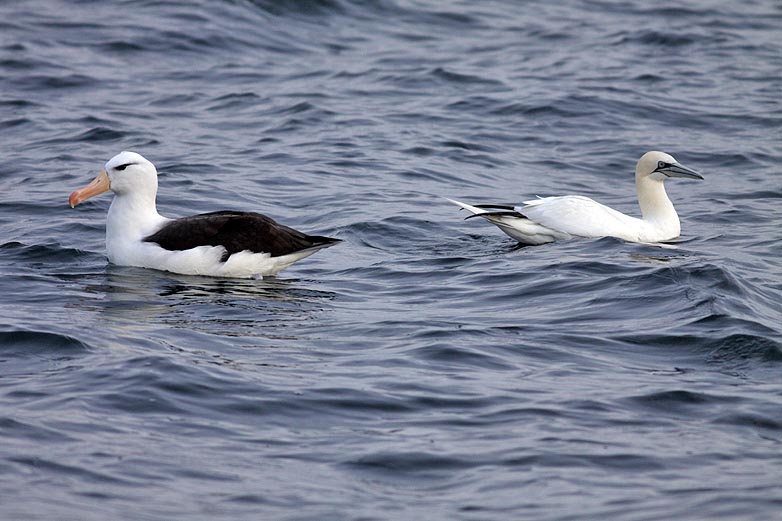
Black-browed Albatross ~ Feb. 18, 2012


One of the toughest aspects of pelagic birding is the unpredictability of it all.  But in order for it to be a viable enterprise, the trips must be scheduled in advance and on a fairly regular basis.  So when we settle on a few dates for running trips, we go ahead and put the word out a few months ahead of time and hope for the best when it comes to the weather, water temperature, and, of course, the "target birds".  Pelagic birding would be nothing nowadays without the "target birds" for a particular trip or season.  Gone are the old days when most birders jumped at the chance to go to sea and find out what might be out there. By now, we mostly know what is likely to be around and we know what probably won't show if the water is too warm or too cold.  It is nice to have that knowledge, but it also puts a damper on things when you know the odds are stacked against you.  After four consecutive years with cold water off Cape Hatteras, some people had begun to think Dovekies were an expected winter visitor to NC coastal waters.  Well, they can be if the water is cold enough.  But Dovekies don't exactly come flocking to 60 or 70 degree water if there is no really cold water just inshore of it.  Since December we have seen fairly consistently warm water here off Cape Hatteras well inshore of the shelf break.  This trend has been in sharp contrast to the fall, when water temps inshore were rather cool, consequently, there have been few alcids - even Razorbills - which are often quite common here in winter.  On the other hand, it has been a good year for Great Skuas, one of the best ever.


When we put to sea on Saturday February 18, I was not exactly sure where we would find the warm water but I knew it would be in fairly close.  I had hoped to avoid it for a while by crossing Diamond Shoals, but I found warm water there just 3 miles off the beach.  This is usually a good place to see Razorbills, but instead we saw a small flock of eastbound Red Phalaropes crossing the shoals around 0800!  We did soon find cooler water on the north side, however, and a Manx Shearwater caused excitement when it appeared among a large number of Bonaparte's Gulls.  I decided to work northward in the cooler water, which was in the low to mid 50's;  I had seeing Razorbill and Great Skua in mind.  We had not gone far when a single Dovekie crossed the wake, heading rapidly to the east.  Knowing how Dovekies sometimes favor a temperature break, I headed offshore.  We did not make it out to that break before a Great Skua crossed our wake - northbound - right back there where we had come from!  I stuck with the plan and, after another skua sighting, soon found a temperature break and color change which held several Red Phalaropes and quite a few Loggerhead Sea Turtles.  We saw Loggerheads at point blank range frolicking next to the boat.  It was quite exceptional.  After a while we gave up on the change and headed back inshore.  We saw a distant skua and a disinterested Northern Fulmar.  I had expected more fulmars based on the last couple of trips.  There was a good showing of gannets closer to shore, with many birds raining down at times.  We saw another skua on the horizon off Avon.  Working southward we found the hot water again to the NW of where it had been earlier.  We saw a few Manx Shearwaters and Razorbills, but nothing close.  We saw more turtles than I have ever seen.  We were less than two miles from Hatteras Inlet when I heard the excited cry of "ALBATROSS!" from the stern.  I stopped the boat and went out on deck.  The bird had landed in the wake, so I ran back to the wheelhouse and turned back on our course.  Coming about, I was shocked to see an adult Black-browed Albatross sitting on the water among our following of gannets and large gulls.  It was not at all worried by the boat;  I went to the stern.  We were almost out of chum, but Kate had made sure we still had enough to keep a flock to the inlet.  She threw out a couple of scoops and the albatross came charging in to the stern, where he easily dominated the gulls and gannets.  It did not take long to finish up the chum, so we spent the next half hour enjoying the bird as it rested and preened alongside.  Thousands of photos were taken and a fishing party even came by to have a look at the giant bird.  Around 5:26 the albatross took flight and headed off the to the eastward, reminding us why pelagic birding (inshore seabirding in this instance...) is not so much about the target birds, but about the opportunity for discovery.


This Black-browed Albatross is one of just a few individuals documented in the Western North Atlantic.  There is one previously accepted sight record for North Carolina from August 19, 1972.  A congener, the Yellow-nosed Albatross, has been seen three times at or near Cape Hatteras, including one of our "pelagic" trips on February 5, 2000.  It was also seen fairly close to shore.


Thanks to everyone who came along, leaders and participants (Kate, Bob Fogg, Dave Shoch, Jeff Pippen & crew).  Leader Bob Fogg gets credit for the find!  


~Captain Brian Patteson


List for the day:
Red-throated Loon - 1
Common Loon - 2
Black-browed Albatross - 1
Northern Fulmar - 1
Manx Shearwater - 4
Northern Gannet - many seen
Red Phalarope - 43
Bonaparte's Gull - many seen
Herring Gull - many seen
Iceland Gull - 1 first winter
Lesser Black-backed Gull - 30 to 35 (more than usual!)
Great Black-backed Gull - many seen
Great Skua - 2
Dovekie - 1
Razorbill - 8 to 10


Humpback Whale - 1
Atlantic Spotted Dolphin - 3
Atlantic Bottlenose Dolphin - many seen


Loggerhead Sea Turtle - 38 plus
Ocean Sunfish (Mola mola) - 1


Yes, a few photos of the Black-browed Albatross:


Amazing gannet sequence in the stern...


Red Phalaropes
Loggerhead Sea Turtle ~


Monday, February 13, 2012

Rematch: Stormy Petrel II: 4, Bonxie: 0 (2/11/2012)

After seeing the satellite photo for Feb. 10, I was a bit more excited about our prospects for the pelagic trip on the following day. It seemed that cold water had finally washed down below the Cape and maybe it would stay for a few days. Then clouds moved in and we could not tell what was going on until we left to find out first hand on Saturday morning. Light rain was falling before we left the dock and the wind, which was predicted to freshen to gale force by early evening, was still light. Unlike the previous weekend, we had a full trip, and everyone had high hopes for a Great Skua. I thought we might get lucky and score a Dovekie or Puffin if we could find a good change east of the Cape, so I headed out toward the shelf break for starters. It did not take long to find warm water. A lot had changed in 24 hours. Where I was hoping for 55 degree water, it was 65 to 70, so we never made it past 20 fathoms there. The first couple of hours out were rather dull, and the only pelagic birds we found were a couple of uncooperative Northern Fulmars. Working to the northwest, we did come upon a rough temperature break and some more target birds by mid morning. All of a sudden we were seeing Razorbills and more fulmars in this cooler water. A young Black-legged Kittiwake also trailed distantly behind the boat. There was a good showing of Loggerhead Sea Turtles, including an amorous pair. We found a small number of Red Phalaropes where the break was sharpest, going from about 60 to 70 degrees. Moving closer inshore, there was a steady procession of gannets, mostly moving northward on a broad front. This was where I felt we might find a skua, but we traveled for miles with no luck. As a consolation prize, a second winter Iceland Gull followed us for miles. Finally at 14:33, George Armistead spotted a skua moving off the port side at medium distance. People were able to see it, as it stayed in view for a while, but never charged us. Less than 20 minutes later, possibly the same Great Skua charged our flock of gulls and gannets, making one nice pass. This was in the same area where we had seen a pair of Bonxies last Saturday. The wind started to freshen and it got cloudier. By the time we had crossed Diamond Shoals, I was about ready to pack it in and steam to Hatteras Inlet. A nice flock of Bonaparte’s Gulls was feeding nearby, so I veered a few hundred yards seaward to check them out, hoping for a Little Gull. There was no Little Gull, but a nice flock of Red-breasted Mergansers was feeding there over three miles offshore! Then it was pandemonium when the brown bomber returned to have a go at our flock. It was the best Bonxie show in at least couple of years and many photos were taken. After the skua peeled off, we did vacate the area, not wishing to be on the water when the gale came on. A few minutes later, a skua did appear behind the boat and followed for a couple of miles. A Manx Shearwater also made a close showing in the wake for Kate and the others back there watching. We got back to the dock ahead of the front, and bunch of happy people disembarked the boat.

Target Seabirds:
Northern Fulmar- 11
Manx Shearwater- 2
Red Phalarope- 5
Black-legged Kittiwake-1
Great Skua- 1 or 2
Razorbill- 35

Rare Gulls:
Iceland Gull- 1 second winter

Other seabirds-
Common Loon, Red-throated Loon, Northern Gannet, Herring, Great Black-backed, Lesser Black-backed, and Bonaparte’s Gulls, Red-breasted Mergansers.

Other Marine life-
Loggerhead Sea Turtle (9), Scalloped Hammerhead (default sp.) (2), and dozens of inshore Bottlenose Dolphins

(By clicking on images you can scroll through them full screen)

Images of Great Skua:
Second Winter Iceland Gull
Northern Fulmar
Subadult Northern Gannet diving amidst the flock
one half of the amorous pair...
Razorbills
Lesser Black-backed Gull
Northern Gannet coming in!
Northern Fulmar joins the melee (note Iceland Gull far left)
Some of the fish heads were very large...

Monday, February 6, 2012

Feb. 4, 2012 Hatteras Pelagic Trip on Stormy Petrel II

Kate Sutherland and I went to sea with a small group on Saturday for the first pelagic trip here since late December. Water temperatures have been remarkably high all winter, so I did not expect to see much in the way of alcids south of Diamond Shoals. With this in mind we decided to check out the west wall of the Gulf Stream first and then make a northwesterly tack to inshore waters a bit north of Avon. We found good numbers of gannets just a few miles offshore, but these birds were mostly heading to the southwest. I figured there would be more gannets to the north of the shoals, so I stuck with the game plan. We found a ragged edge with water temperatures up to about 70 degrees just a few miles SE of Diamond Tower. I was hoping to find a number of Bonaparte's Gulls and Red Phalaropes along this condition, but that did not pan out. We saw a couple of phalaropes where we landed on the change, but the next ten miles was, unfortunately, devoid of phalaropes. There were several Northern Fulmars working around the change, however, and we had great looks as they landed repeatedly on the water nearby and circled the boat. Kate's chumming attracted a lone Great Shearwater, which put on a show diving for bait the gulls could not reach. A single Manx Shearwater made one pass up the starboard side of the boat at medium distance. We also saw at lest half a dozen Manta Rays feeding along the change. The change became more diffuse as we traveled northward, so I gave up on looking for phalaropes and Dovekies offshore. Working back in to the beach, it was fairly quiet, but we did find a small concentration of Boneys feeding around some foamy water. Closer to the beach, within five miles or so, we found good numbers of gannets, dozens of Bottlenose Dolphin and a few Loggerhead Sea Turtles. A few of us got a look at a distant skua that was rapidly heading north. I decided to head south and I hoped for another skua sighting around Diamond Shoals. We saw a few Razorbills along the way south, all flying birds. Around the north end of the shoals, a pair of Great Skuas crossed our bow heading offshore in the same direction as most of the gannets in the area. We jogged offshore for a little while, hoping they might circle around and harass some birds, but it never happened. Across the shoals, it was fairly quiet back to Hatteras Inlet, but we did have nice looks at a swimming Razorbill. The wind was picking up from the southwest when we got back to port, and it made me think about how lucky we had been with the weather. The only whitecaps we saw were small ones at the edge of the Gulf Stream, and there had been no spray all day! It had been a great day to explore the ocean and take photos, even if the birds were a bit sparse. We found out the skuas were there, and now we'll see if they want to play on Feb. 11!

Seabirds & Marine Life ~

Red-throated Loon - I only saw one close to the boat, probably more closer to the beach
Common Loon - 17; several well offshore
Northern Fulmar - 15+; could have been a few more
Great Shearwater - one
Manx Shearwater - one
Red Phalarope - 3; one inshore
Great Skua - 3; not interested in our feeding flock today
Iceland Gull - one first winter, followed the boat
Razorbill - 26; mostly flying birds, good looks at one

Loggerhead Sea Turtle - 7; a few well inshore
Manta Ray - 6; all along "the change"
Bottlenose Dolphin - dozens of dozens; best numbers off Avon and near Hatteras Inlet
Little Tunny (False Albacore) - many seen chasing bait at surface inshore of Gulf Stream

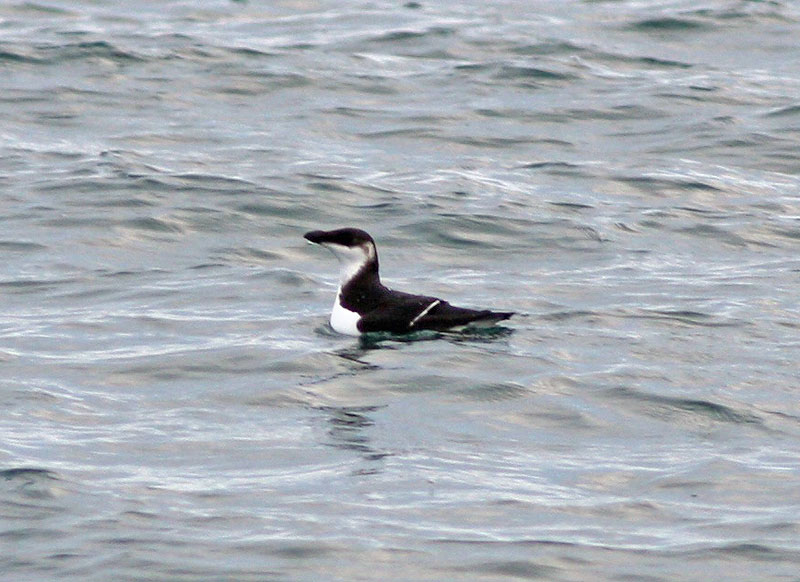
Images from the day: Razorbill on the water, Great Shearwater after a dive, Northern Fulmar on "the change", & Iceland Gull

Tuesday, January 17, 2012

Steve Howell Raises Bar with Tubenose Book

Last Friday I finally got my hands on Steve Howell's latest masterpiece-
Petrels, Albatrosses & Storm-Petrels of North America: A Photographic
Guide. As the dust jacket proclaims, this is "the first state of the
art guide to these enigmatic seabirds." That is no exaggeration. Steve
has been working on what we have come to call the "tubenose book" for a
long time. He has probably spent a thousand hours on my boat over the
last six years alone. And he lives in California, where he has been a
popular leader on pelagic trips for at least a couple of decades. In
addition to the requisite experience for writing this book, Steve has
also seen all but a few of the world's tubenoses including several rare
and critically endangered species. Best of all, however, Steve is a
superb teacher and writer. So for those who are eager to learn about
these birds, we now have an excellent text.

Steve has authored several highly regarded bird books in the past,
including his epic Mexican guide, a guide to molt, and books about
hummingbirds and gulls. Depending on the publisher, however, those
books were not always organized to full advantage. The gull book, for
example, had photos in the front and text in the back- a rather
inconvenient arrangement. The tubenose book, however, has photos
running throughout which is a tremendous advantage, especially to those
of us with attention difficulties. There is rather long introduction
(nearly 50 pages), but unlike so many dry, tedious "intro's," this one
is highly readable. The introduction is also essential reading for
most, because it presents (in a nutshell) the basic set of instructions
necessary if one is to truly learn these birds. Having been involved
with pelagic birding for so long now, it is difficult for me to relate
to some of the perceptions of landlubbers when it comes to seabirds.
Therefore, I suspect Steve's introductory section will be like cracking
our code for some birders. Without such a comprehensive introduction,
this would be more of a book for old salts.

As Steve says, it is tempting to just open the book and look at the
pictures. That is, of course, just what I did. It is amazing to me,
what Steve has done as a photographer in making this book. There are
literally hundreds of excellent photos, and Steve took the vast majority
of them in less than five years! There is no question that this state
of the art work would not be what it is without the advances in digital
imaging. Without a reliable autofocus camera with which to take
thousands of photos for the cull, it would not have been possible to
produce this book competitively in a reasonable amount of time. I'm not
knocking Steve as a photographer and I do not mean that anyone could
have done the same quality work with a digital camera. But there is no
question that it would have been a lot harder and more expensive to do
with film. Steve has also made careful choices with the photos and his
captions do a lot of the teaching, so you CAN learn a lot by just
looking at the pictures.

To skip the text, however, would be a big mistake. Steve is an engaging
writer and he has done a very effective job in communicating his
knowledge here. The reader is rewarded with concise presentation of the
latest word in taxonomy, status, distribution, and identification of
some 76 taxa of seabirds. This book presents some of the first readily
accessible information about cryptic species of "Band-rumped"
Storm-Petrels in the Atlantic, and what have been called "dark Leach's
Storm-Petrels" off the West Coast. Thorny ID problems such as Cory's
and Scopoli's Shearwater and Fea's and Zino's Petrel are tackled. And
with photos running throughout the family and species accounts rather
than in a separate section, these discussions are easy to follow and
comprehend. There are also excellent range maps for all of the
regularly occurring species.


In short, this new "tubenose book" is absolutely indispensable for
anyone who plans to look at pelagic birds off the East Coast, West Coast
or the Gulf Coast. And it would be very interesting reading for those
who have done a lot of pelagic birding in years past, to see what we
have learned over the last couple of decades.

I cannot claim to be an impartial reviewer in the case of this book.
Along with Debi Shearwater, both Kate Sutherland and myself are given
credit by Steve as collaborators. But I am finding it hard to find much
fault with this book, which itself was written by one of the toughest
reviewers of bird books we know today.

This book is available through the Princeton Press website-
http://press.princeton.edu/titles/9534.html

Friday, December 30, 2011

December 29, 2011 ~ Final Pelagic Trip of the Year!

We finally got a break in the weather and ran the pelagic trip we had originally scheduled for Tuesday or Wednesday on Thursday the 29th.  I did not expect much in the way of alcids because the inshore waters had been warmer than usual for a few days (after being cooler than normal in November!), and we found ourselves in 60 degree water for most of the day.  The water was warm even to the north of Diamond Shoals, and we saw only nine widely scattered Razorbills all day: a quad near Hatteras Inlet in the morning, a trio at the Gulf Stream edge, and then a nice close pair a few miles east of Avon in the afternoon.  On the other hand, we did have good diversity of tubenoses with two or three Great Shearwaters, a couple of Black-capped Petrels, a scrappy little Northern Fulmar, and a flyby Manx Shearwater.  We found Red Phalaropes in low numbers but at three widely scattered locations, with most of them along a seven degree temperature break on the western side of the Gulf Stream.  Such breaks can be good places to see other marine wildlife, and yesterday's most interesting non-avian wildlife were the Manta Rays we saw feeding at the surface along the color change.

Throughout the day we kept a steady procession of gulls and gannets behind the boat and it finally paid off in the early afternoon.  From the wheelhouse I saw Ali Iyoob pointing skyward at a bird I could not see from the helm.  I stuck my head outside and there it was - a Great Skua coming in high to ambush the gulls.  In typical Bonxie fashion, it streaked by the boat quickly and briefly engaged some distant straggling gulls before disappearing from sight.  It was number 743 for John Vanderpoel, who has been doing an ABA area Big Year.  John's list so far is the highest of any that has not included a visit to Attu, and he is quite close to the all time record.  I would like to thank John for wanting to search for a skua, and everyone else for having the faith that we would see some interesting birds even if it wasn't February, which is when we run most of our winter trips.  I would also like to thank Kate Sutherland for her tireless work on the deck, dispensing the chum from start to finish, spotting birds, and no doubt answering a lot of questions from an excited group of birders who were happy to be out for the sake of a good day at sea and thankful for the birds we found along the way.  It was a good mix of "regulars" and new participants, with more young people than most trips.  Thanks everyone for making it happen.  Maybe we can make it an annual event.

Our next trip is planned for January 14 or 15, which some people might find convenient because of the King Holiday that Monday.  We also have several trips planned for February, but the double header on President's Day weekend is already fully booked for Day One.  A lot can change with the water here over a couple of weeks, and with the recent news of Dovekies in the surf off Kill Devil Hills, it would not surprise me to see them here soon. 

Brian Patteson
brian@patteson.com


Updated January 6, 2012 for photos...
Some photos from one of our student participants, Ali Iyoob, North Carolina.  As follows: Northern Fulmar, Red Phalaropes, color banded Herring Gull, and feeding Manta Rays!