Tuesday, May 17, 2022

Mid-May is Magical! ~ 13, 14, 15 May 2022 by Kate Sutherland

Mid-May can be a great time for seabirds offshore from Hatteras, however the weather can be a bit unpredictable.  So as we approached our Friday May 13th trip date we were just finishing with a nor'easter that sat offshore here and wreaked a bit of havoc on the highway to Hatteras village...luckily the winds and seas subsided early Thursday morning and the highway was open for business by midday.  A large weather system like that can make for some interesting birding in the days that follow, if we can get out there.  We were lucky on Friday and despite dense fog on the way to the ocean, we made it offshore and conditions were excellent for birding.  As were the conditions the following day when we had some down current (an eddy in the Gulf Stream that is moving the opposite direction from the usual north easterly flow) and easterly wind.  By Sunday conditions were much calmer and skies clear - each day was unique.  For this reason we typically recommend taking more that one trip with us when you're here, availability permitting!

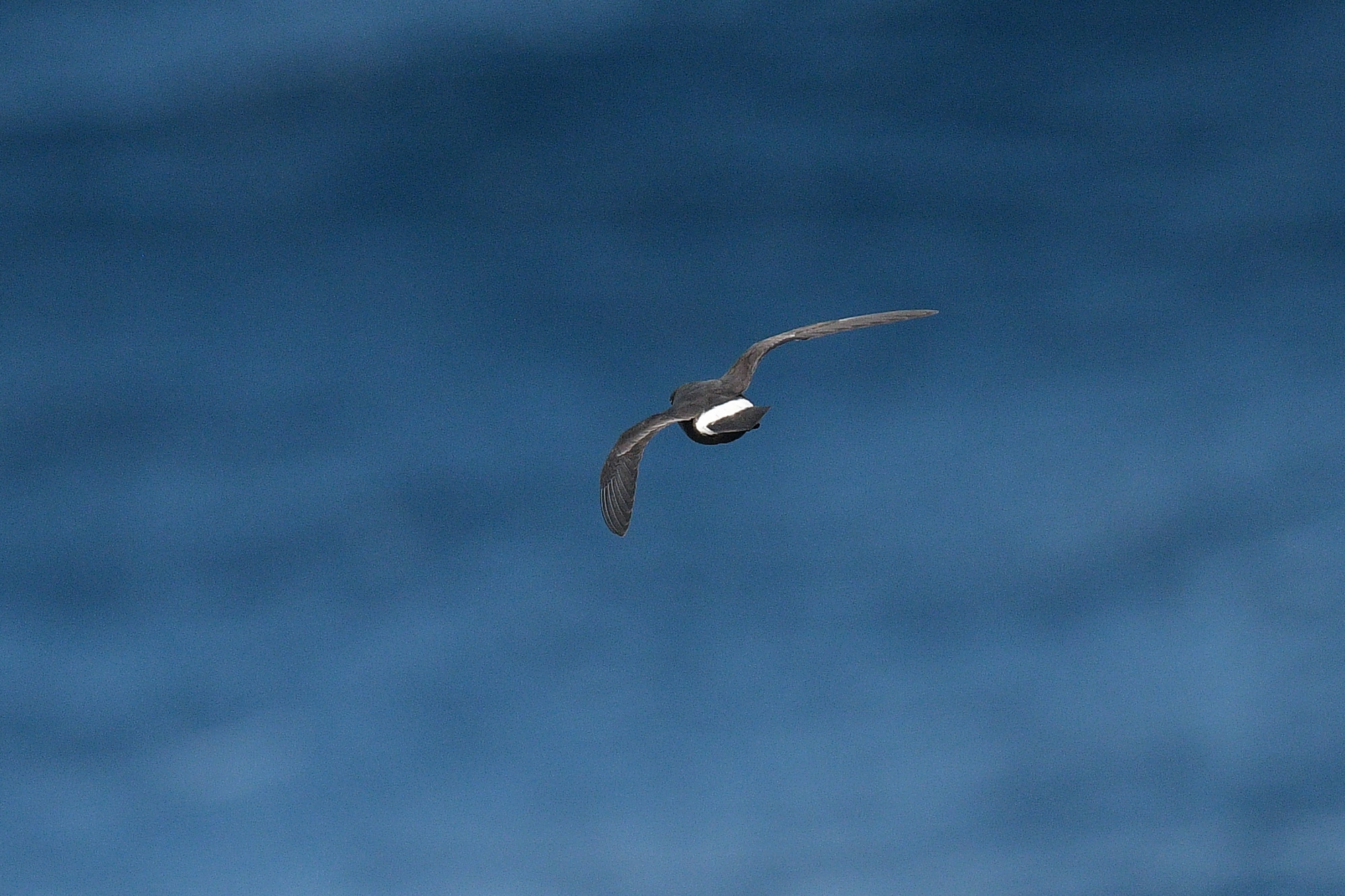
The definite star of the weekend was the European Storm-Petrel we had Saturday morning less than an hour after crossing the shelf break!  This bird was spotted by myself and Jamie Adams simultaneously as it darted across the stern flashing its diagnostic white bar under the wings!!  After some pandemonium as we worked through the excitement of having a look at this species that hasn't been seen offshore here since June 1, 2019, we got people situated and did our best to call out the flight direction and identification criteria as it moved in a flock of Wilson's Storm-Petrels.  Hopefully most everyone saw it during its brief visit in challenging seas - by the time I took a minute to photograph it, it was not close and also flying away...but even so, this image with the dark upper wing and thin pale margin to the secondary coverts in addition to the short legs, is enough (Kate Sutherland) to identify it!
Later that same day we had a super cooperative Fea's Petrel come to investigate the slick after being glimpsed at a distance for some time.  This is the third sighting of this species for the spring, and it looked likely to be a Deserta's Petrel, one of the species in the Fea's Petrel complex (the others being Cape Verde Petrel and Zino's Petrel) and the one we think is most likely seen offshore from Hatteras.  We had some rain on Saturday, but that didn't slow or deter this bird from coming to check out the slick!  There were excellent views for all aboard (Kate Sutherland).
Friday we were treated to a gorgeous, adult White-tailed Tropicbird who was also super cooperative and interested in our chum!  It came to the boat and flew around multiple times at close range, swooping down to investigate us in the stern.  Looking over my photos as we headed back to the dock that afternoon I realized the bird had a band on its left leg!  A quick message to Jeremy Maderios, Bermuda's senior terrestrial conservation officer and Keeper of Cahows and Longtails there, confirmed that he does band chicks fledged from Bermuda on the left leg to track that they are a known age / location individual.  This bird was banded by him as a chick and is the first we have seen offshore here with a band!  Since 2006 Jeremy has banded about 1,700 White-tailed Tropicbird (Bermuda Longtail) chicks.  (top photo Bob Fogg, lower showing band by Kate Sutherland)
To top off the three day set we had a Brown Booby on Sunday's trip that flew by, showing well, but not coming in very close.  (Bob Fogg)
In addition to these encounters we had excellent luck with our Gulf Stream specialty the Black-capped Petrel seeing multiple individuals each trip and all days had some close passes.  While we didn't find many, we did have Audubon's Shearwaters on each trip, and another species we hope to find in the warm water, Band-rumped Storm-Petrel, made an appearance each day as well (Kate Sutherland). 
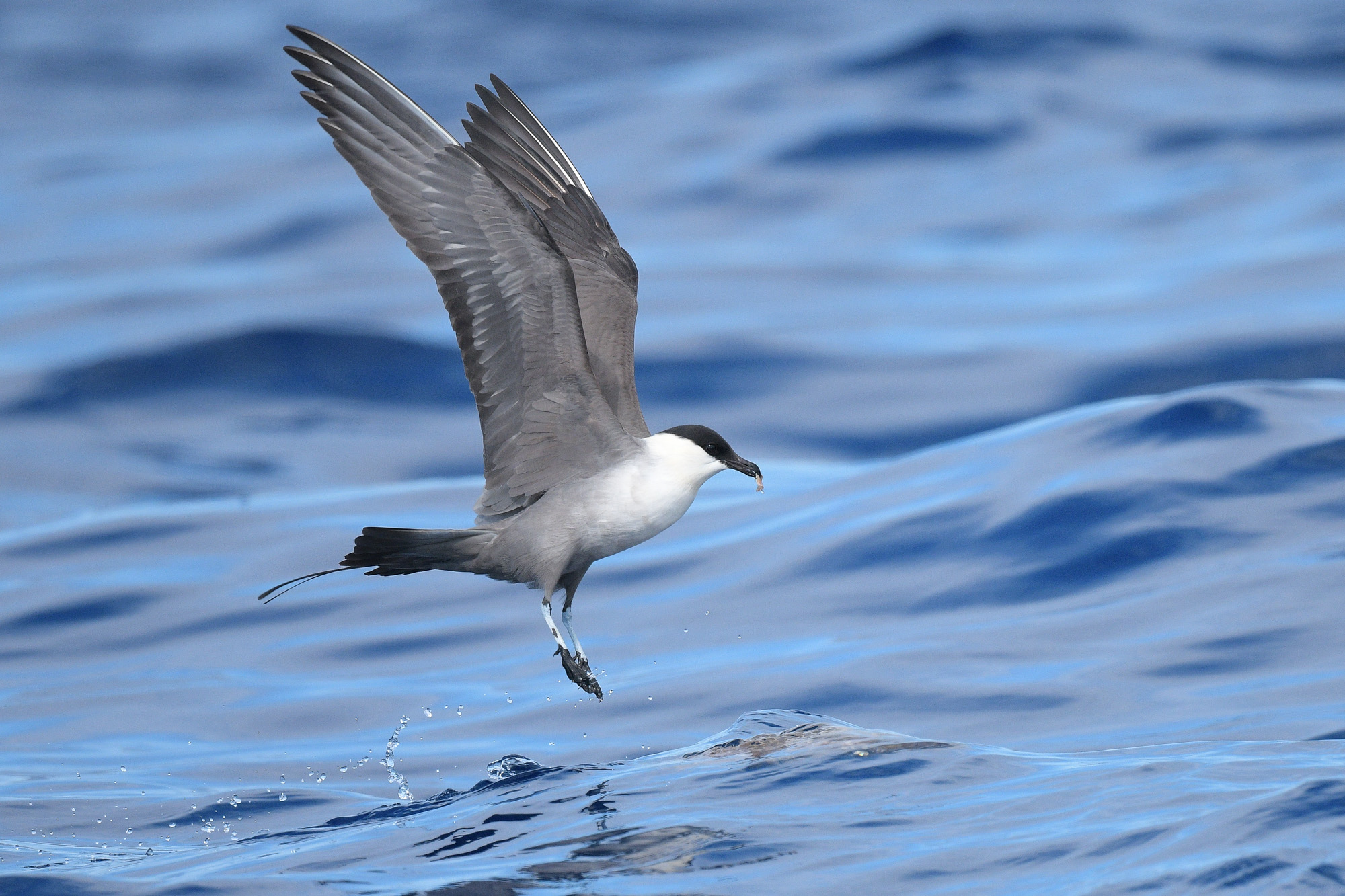
Atlantic Cory's Shearwaters are starting to show up, and the storm-petrels were just incredible with hundreds of Wilson's Storm-Petrels following us each day and multiple Leach's Storm-Petrels seen with them.  Pomarine Jaegers loyally stayed with us eating bits of fish as we motored, Parasitic Jaegers were seen best on Friday but we had at least one each day, and a Long-tailed made a pass on Saturday's trip.  Arctic Terns showed well on all three trips coming in to the boat and feeding for some time on chum before moving on.  A highlight for us was seeing both species of phalarope, sometimes together, on each trip!  There are still a few Red Phalaropes around and we had excellent views of this larger species on the water each day with the more numerous Red-necked Phalaropes also showing well!  Overall it was a great time out there even with some larger seas, fog, and rain making birding a challenge!    

Thanks so much to everyone who joined us making these mid-May trips possible!  A huge thank you also to Bob Fogg for joining us as a leader on all three trips and sharing his photos with us, Matthew Withrow who also helped on all three days, Matt Jansen who joined us Saturday, and Sarah Toner who joined us Sunday.  We couldn't do it without them!  The Spring Blitz begins on Friday...these reports will be brief, but we'll keep you posted!

Species List May 13 / 14 / 15, 2022

Red-necked Phalarope 35 / 60 to 61 / 72
Red Phalarope 2 / 2 / 33
Pomarine Jaeger 12 to 16 / 15 to 17/ 8
Parasitic Jaeger 6 / 2 / 1
Long-tailed Jaeger 0 / 1 / 0
jaeger species 0 / 2 / 1
Common Tern 37 / 11 / 0
Arctic Tern 4 / 9 / 3
Common / Arctic Tern 55 to 57 / 78 to 83 / 2
White-tailed Tropicbird 1 / 0 / 0
Wilson's Storm-Petrel 340 to 360 / 390 to 420 / 245 to 265
European Storm-Petrel 0 / 1 / 0
Leach's Storm-Petrel 7 to 8 / 11 to 15 / 2
Band-rumped Storm-Petrel 1 / 5 to 7 / 2
Fea's (likely Deserta's) Petrel 0 / 1 to 2 / 0
Black-capped Petrel 39 to 40 / 61 to 63 / 45 to 54
Atlantic Cory's Shearwater 32 / 22 / 16 to 19
Cory's / Scopoli's Shearwater 5 / 3 / 12
Audubon's Shearwater 2 / 7 to 8 / 6 to 7
Brown Booby 0 / 0 / 1
Barn Swallow 0 / 0 / 3
Other species seen in the nearshore waters include:
Herring Gull
Least, Sandwich, & Royal Terns
Common Loon
Northern Gannet
Least Sandpiper
Red Knot
Other Marine Species:
Pilot Whales (likely Short-finned) 0 / 0 / 2
Atlantic Spotted Dolphins 0 / 14 to 17 / 0
Offshore Bottlenose Dolphins 7 / 0 / 0
Loggerhead Turtle 2 / 11 / 6
Portuguese Man of War 0 / 0 / 4

And now the photos!!!  We'll begin with some Black-capped Petrels.  We saw both the white-faced and black-faced birds over the course of the weekend and they were all in varying stages of molt as we would expect with different age birds nesting at different times.  Top image is an intermediate tending darker individual by Kate Sutherland, below a white-faced bird by Bob Fogg.
One similar to the first bird pictured flying with some Wilson's Storm-Petrels in the slick (Kate Sutherland)
Fea's (Deserta's) Petrel getting after one of our Pomarine Jaegers!  (Kate Sutherland)
A couple more White-tailed Tropicbird images (Kate Sutherland)
And another image of the Brown Booby (Bob Fogg)
Wilson's Storm-Petrel on the water (Bob Fogg)
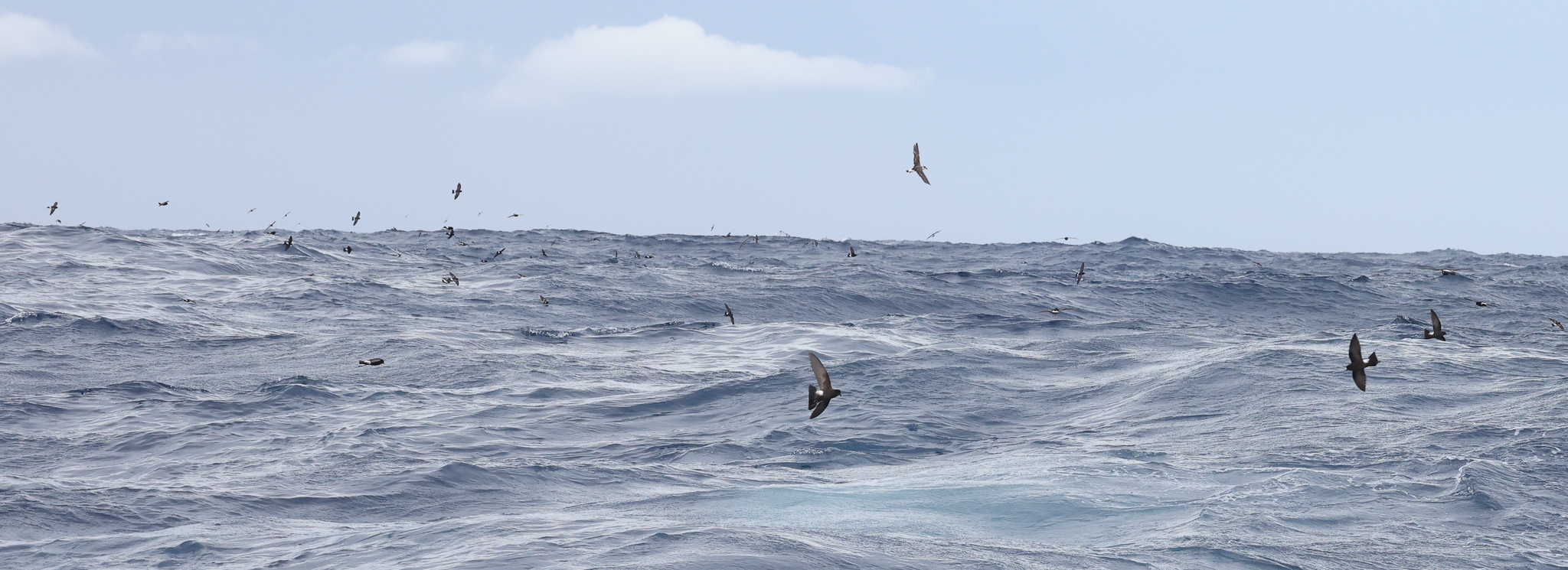
And a gorgeous seascape with Wilson's and Black-capped Petrel, also by Bob Fogg
 A couple Wilson's feeding on chum as we tried to lure the Euro back to us! (Kate Sutherland)
The blue / green color change on Friday with a Wilson's Storm Petrel, green water obviously in the foreground! (Kate Sutherland)
Wilson's Storm-Petrel with a car carrier in the background on Saturday. (Kate Sutherland)
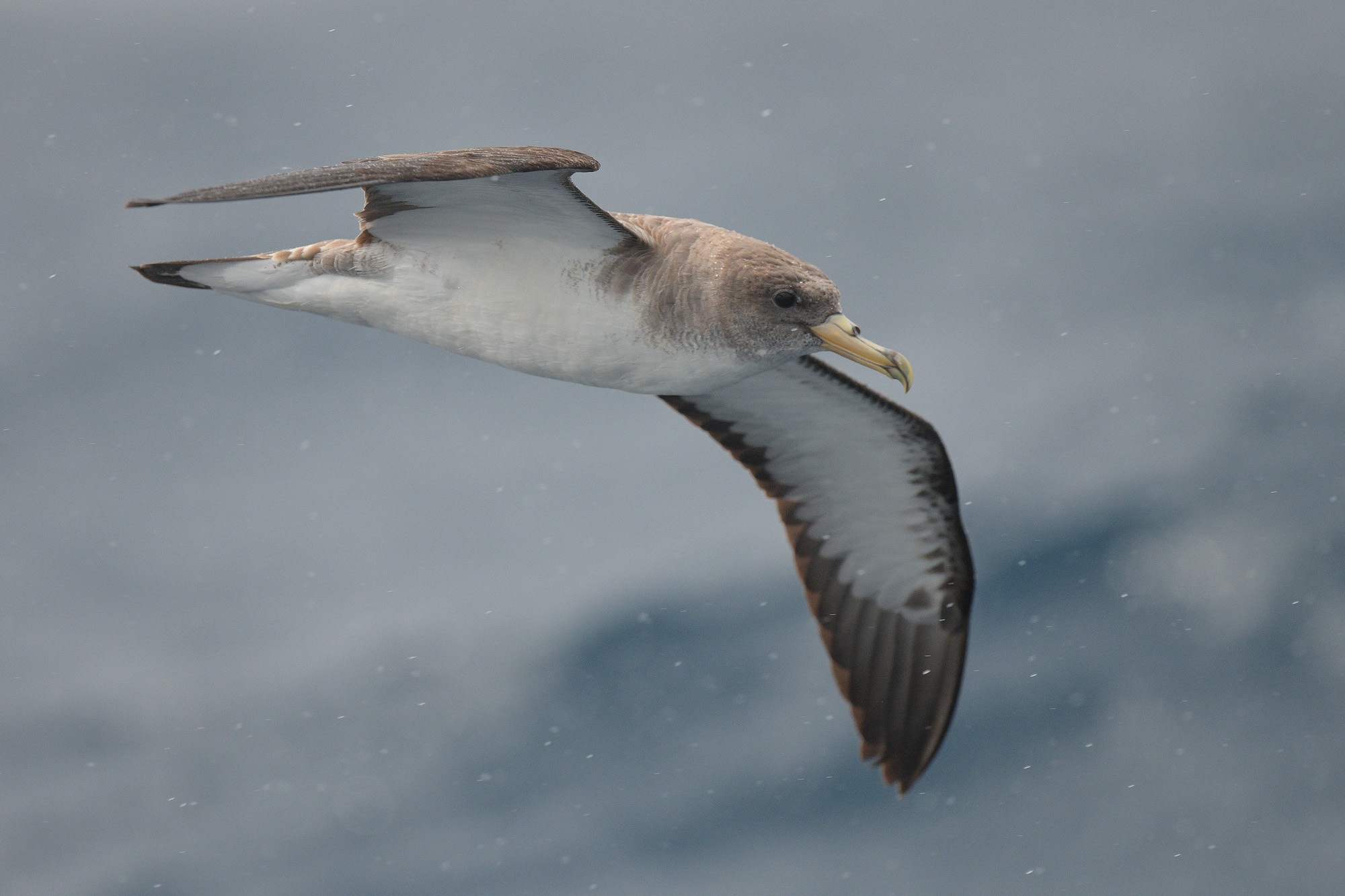
We didn't find any Scopoli's Shearwaters out there, but we had some really nice views of the Atlantic Cory's! (Kate Sutherland)
Seen here with a Wilson's Storm-Petrel (Kate Sutherland)
Pomarine Jaegers were super cooperative as I mentioned in the trip report, here are a few images from the three day set! (top Bob Fogg, bottom two Kate Sutherland)
Eating some chum close to the stern!
Parasitic Jaeger (Bob Fogg), this top individual was a cooperative one from Friday's trip and the bottom is all we sometimes get from Sunday's trip!
The phalaropes were such a treat!  Here is a Red Phalarope (top), one with a Red-necked Phalarope (middle), and some Red-necked Phalaropes (bottom) - images by Kate Sutherland
And finally one of the Portuguese Man of Wars we saw on Sunday!  (Kate Sutherland)

Thursday, May 12, 2022

Early Spring: Yes. ~ 29, 30 April 2022 by Kate Sutherland

For years we've been trying to get strong support for some earlier trips than we run during the "Blitz" around the end of May / beginning of June.  We've had some incredible seabirding out there over the years, but people tend to just use eBird now to gauge their desire to do trips...and we have a disproportionate amount of trips we've run from May 20 - June 10 or so, and we hear from participants looking for a pelagic trip regularly that it's the "only time to go."  Yet we have trips we run at many other times of the year and we see incredible birds - however the lists and numbers from late spring, simply due to the high number of trips we run at that time, are in the forefront utilizing a database like eBird... again because so many people want to go at that time...makes it much more difficult for us to run a balanced schedule in the spring and summer.  Yes, late spring can be an excellent time to be in the Gulf Stream!!  Band-rumped Storm-Petrels begin to show up at the end of May, Great Shearwaters and Scopoli's Shearwaters begin to show up around that time or early June as well, the weather still has a bit of volatility to it which can be really wonderful to get seabirds moving...but depending on the conditions there can be really incredible seabirding out there earlier and later than the "Blitz!"

Okay, to get to our current trip report!!  This spring we scheduled a few more trips in late April / early May to see if we can start to build up those stats and see what might be easier to see earlier in the season!  Participation was not overwhelming, but we garnered enough support to make seven trips a go.  The first of these, April 29 and 30th, I will cover here, the second set, May 7 and 8th, had to be canceled due to this incredibly large system that sat over us for most of this week, and the third set we hope to run over the next three days (May 13, 14, 15).  Thank you so much to all of you who made these trips possible!  In early May 2019 when capturing Black-capped Petrels in the deep for a tagging project with American Bird Conservancy, all of the rare gadfly petrel species we can see here were recorded - Fea's (likely Deserta's), Trindade, and TWO Bermuda Petrels - were all seen in addition to the Black-caps.  It's a big deal to run a trip in North America and regularly see a gadfly petrel!  Many people forget that. 

And yes, we had a Fea's (likely Deserta's) Petrel on April 29th, it did not come close to the boat, but everyone was able to see it well.  Then on the 30th we had a small gadfly petrel on the shelf near some fishing boats - we've seen Bermuda Petrels fairly close to the shelf - but one participant reported seeing the dark underwings, Brian saw the uniformly gray upper parts, it was also likely a Fea's Petrel.  Black-capped Petrels were seen well on both trips, especially since we had a flock of Pomarine Jaegers behind us feeding on chum and Black-cappeds regularly harass these birds that sometimes kleptoparasitize other seabirds (Pom & Black-capped, Kate Sutherland). 

Needless to say we were treated to some aerial pursuits close to the stern!  We were happy to see Wilson's Storm-Petrels out in force and had a couple hundred in our slick on both trips.  Saturday's trip also had Leach's Storm-Petrels in the slick from start to finish!  It was a treat to watch these larger stormies wheeling above the horizon back in the slick and as they outpaced the smaller, shorter-winged Wilson's approaching the boat.  On both trips we had close encounters with Long-tailed Jaegers, one on Friday fed on the chum with the Wilson's paying the Stormy Petrel II little mind! (Kate Sutherland) 
Atlantic Cory's Shearwaters were around each day with some close passes, and Saturday we also saw one super cooperative Great Shearwater and a couple of Manx Shearwaters gave us a quick pass that afternoon.  Bridled Terns were seen on both trips, maybe this time of year is even better for them than later in the spring, who knows?  We hope to find out over the next few seasons!  Another bonus were sightings of both Red and Red-necked Phalaropes.  We had both species together on the water on Saturday and it was really cool to have a chance to see the Red Phalaropes changing from basic to alternate plumage alongside the smaller, more delicate looking Red-necked Phalaropes with their thin, dark bills and red necks! (Kate Sutherland) 

Late April is a great time to be offshore here and we hope to offer more April trips next year!  We hope some of you can join us to help build up those species lists that will entice more birders to join.  Thanks so much to everyone who came offshore with us and a huge thank you to Steve Backus who helped Brian and I to lead both of these trips!  All photos today are mine ~ Kate Sutherland :)

Participant Donna Wilder photographing Common Terns that were riding on the bow on our way in on Saturday April 30th!

Species List April 29 / 30, 2022

Red-necked Phalarope 22 / 6
Red Phalarope 0 / 8
Red / Red-necked Phalarope 0 / 5
Pomarine Jaeger 23 to 25 / 12 to 13
Long-tailed Jaeger 1 / 2 to 3
jaeger species 1 / 0 likely Parasitic Jaeger
Bridled Tern 2 / 2
Common Tern 3 / 17
Common / Arctic Tern 0 / 9
Wilson's Storm-Petrel 207 to 217 / 165 to 175
Leach's Storm-Petrel 0 / 9 to 12
Fea's (likely Deserta's) Petrel 1 / 0
small Pterodroma species 0 / 1 likely Fea's Petrel
Black-capped Petrel 60 to 64 / 33 to 37
Atlantic Cory's Shearwater 4 / 5
Great Shearwater 0 / 1
Manx Shearwater 0 / 2
Barn Swallow 0 / 1
Ovenbird 0 / 1
Other species seen in the nearshore waters include:
Laughing and Herring Gulls
Common, Black, & Royal Terns
Common Loon
Northern Gannet
Whimbrel
Cetaceans:
Offshore Bottlenose Dolphins ~45 / 0
Atlantic Spotted Dolphins 0 / 7 to 10 bow riding
Fishes:
Ocean Sunfish (Mola mola) 1 / 0
Scalloped or Carolina Hammerhead 0 / 1

Black-capped Petrels - we had both the white-faced type (top two images) and black-faced individuals as well (bottom).
A head-on Black-capped!
Atlantic Cory's Shearwater
Our super cooperative Great Shearwater!
Wilson's Storm-Petrel & a nice group of them on the chum
Leach's Storm-Petrels
A couple of Pomarine Jaeger images - light morph top and a dark morph below
One with a bit of chum!
Long-tailed Jaeger
Red-necked Phalaropes
Common Loon on our way out the first morning
One of the Common Terns that chose to ride with us on the boat railings on our way back in Saturday!
And no way we could forget the Ovenbird!

Friday, March 4, 2022

Sunday February 27, 2022 - Murre Mania - by Brian Patteson

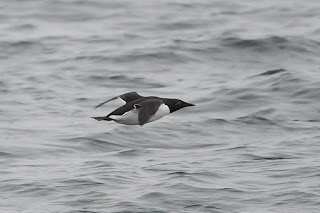
We had to push the trip back to Sunday because of a hard blow from the north on Saturday, but had reasonable conditions at the Oregon Inlet Bar on Sunday morning. We were under the bridge by about 0700, and we didn't have to go far to find some life. We saw over 200 Razorbills and almost 300 Red-throated Loons within the first half hour, and we also spotted our first Common Murre (Kate Sutherland).
By 0830, we had added five more Common Murres, Little Gull, Manx Shearwater, and we were up to well over 1000 Razorbills. Common Murres continued to show well and we saw five more plus a couple of Thick-billed Murres over the next half hour. We had to go a little farther out to find some puffins, but we started seeing a few just over two hours from the inlet (Kate Sutherland).
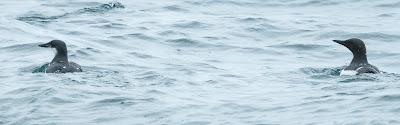
There were definitely not nearly as many birds about ten miles off the beach, but we pressed onward, and we were eventually rewarded with a couple more Manx Shearwaters, a Northern Fulmar and the highly sought after Great Skua. The skua didn't stick around, but it made an impressive appearance, sending our gull flock skyward when it came blasting through. By mid morning we were in the rain, but fortunately it wasn't very heavy. Water was in the mid 50s about 24 miles from the inlet- about 10 degrees warmer than it was near the beach. It didn't look like there was a promising condition for phalaropes, so we tacked back inshore. We picked up several puffins along the way, along with a couple more fulmars that came in close. By 1300 we were back into the Razorbills and murres. We had several flybys, but we also found a group of three Common Murres and one Thick-billed Murre on the water for a rare direct comparison right beside the boat (Kate Sutherland).
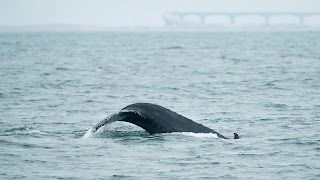
We also managed some better looks at Little Gull and had a Humpback Whale showing well about five miles from the inlet. Razorbills were going by beak to tail right up to the end, and we finished the day with over 2800, which I believe is a new record for the boat. I would like to thank Kate Sutherland, Jesse Anderson and Matt Janson for helping lead the trip. And thanks to everyone who joined us; we had some newbies and they really hit the jackpot on their first trip.  

Most photos by Kate Sutherland, but a huge thank you to participants Rick Wilhoit and Matt Spangler for allowing us to use some of theirs here as well!

Species List February 27, 2022

Red-breasted Merganser - 105
Great Skua - 1
Common Murre - 25 to 27 * NC high count
Thick-billed Murre - 5 * NC high count
Razorbill - 2,838
large alcid species - 5
Atlantic Puffin - 34
Bonaparte's Gull - 34
Little Gull - 2 adults
Ring-billed Gull - 1
Laughing Gull - 1
Herring Gull - 134
Lesser Black-backed Gull - 15
Great Black-backed Gull - 13
Red-throated Loon - 401
Common Loon - 64
Northern Fulmar - 5
Manx Shearwater - 9
Northern Gannet - 55

Humpback Whale - 1
Bottlenose Dolphins - 16+

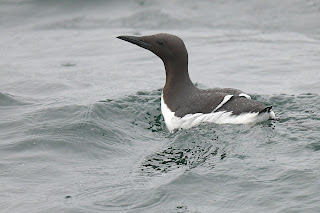
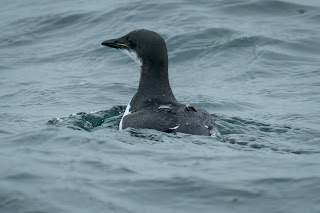
We saw Common Murres in basic plumage, like the bird above in the report, and a number in alternate plumage.  Here is a bird with typical alternate plumage (top, by Kate Sutherland) and a "bridled" type in flight (below, by participant Matt Spangler). 
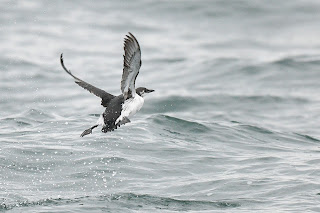
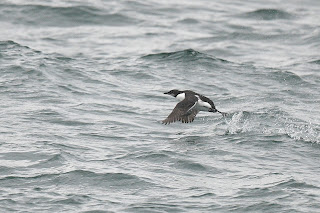
A basic plumaged Common Murre taking off.  (Kate Sutherland)
Participant Rick Wilhoit took this stunning image of our afternoon Thick-billed Murre that so patiently sat for us with a Common Murre (pictured below - also taken by Rick)
One of the first Thick-billed Murres of the day was photographed first and then identified - these murres definitely kept us all on our toes! (Kate Sutherland)
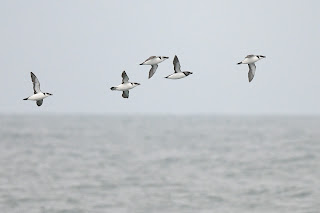
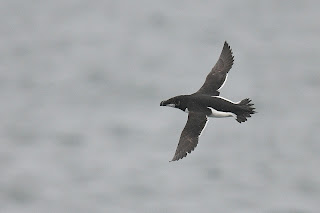
Razorbills were out there in huge number Sunday!  The were seemingly everywhere on the water and in flight when we were closer to the beach. (Kate Sutherland) A number were coming into alternate plumage, as you can see below.
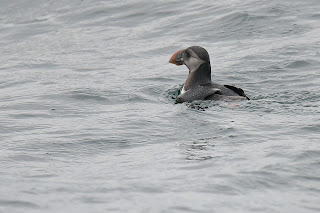
While most of the Atlantic Puffins we saw were young individuals likely hatched last calendar year, I did capture this bird that looked to be possibly a second year or older. (Kate Sutherland)
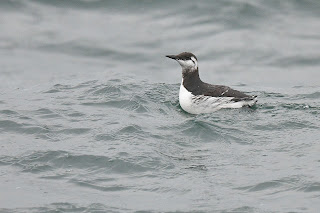
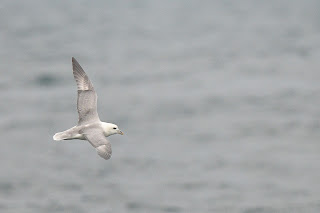
It was super exciting to finally see some Northern Fulmars!  (Kate Sutherland)
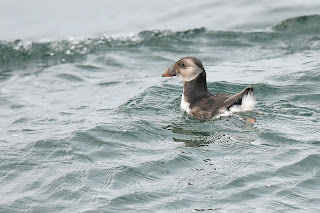
And finally, to bid you farewell (with this winter one for the record books!), our super cooperative Humpback Whale from Sunday afternoon courtesy of participant Rick Wilhoit - thanks so much everyone!!