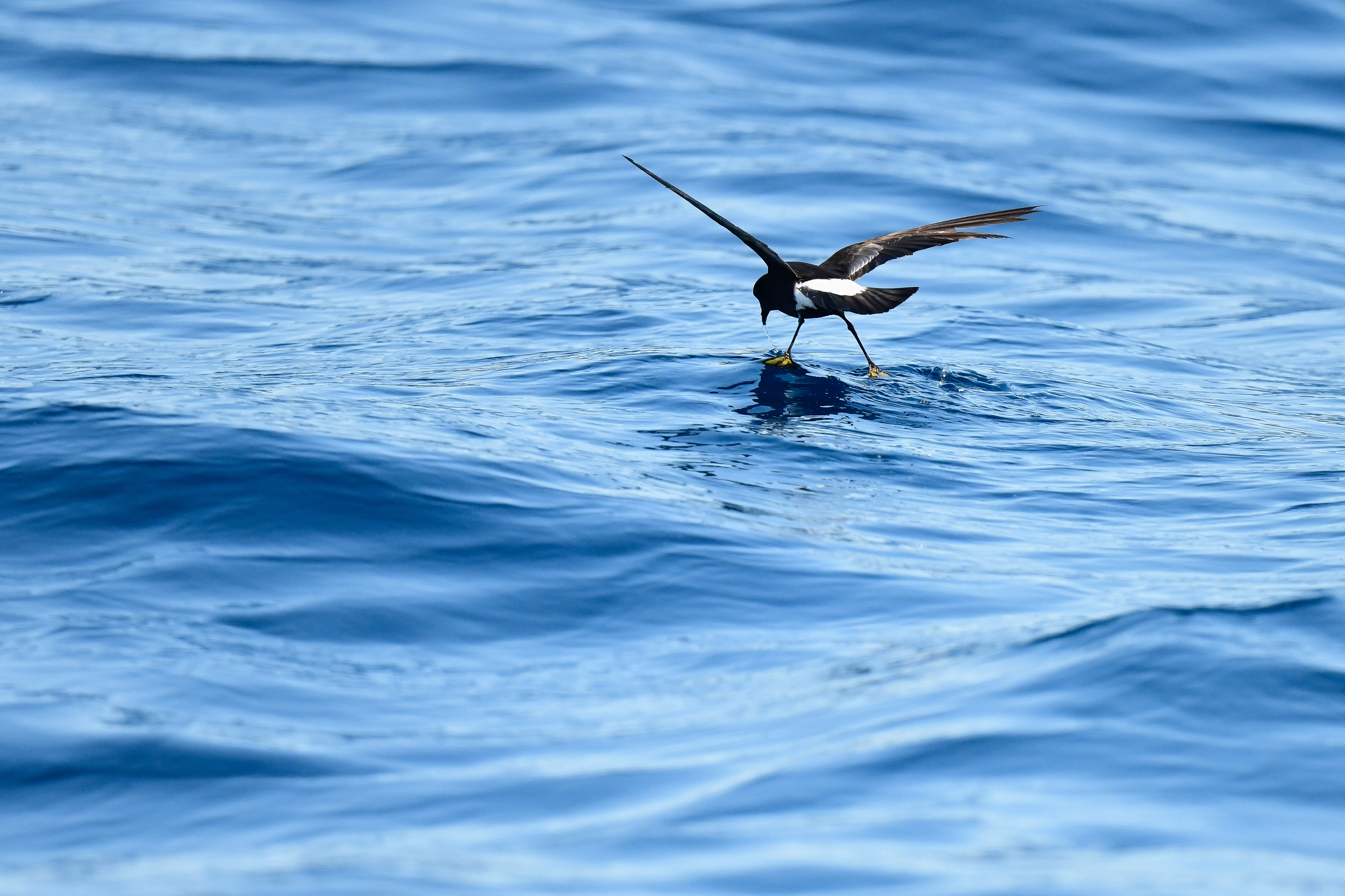
This is a name we've used for this area offshore of Hatteras Island, NC for years and this set of trips just reinforced how incredible seabirding can be here! Pterodroma is the genus of gadfly petrels - like the four species we saw on these trips! Friday the 17th of May we had a Desertas (Fea's) Petrel that came in to visit us on the slick, Saturday we had a Cahow (Bermuda Petrel) visit us and stay around for over 20 minutes (!!!), then on Sunday we were treated to a close Trindade Petrel. Every trip had excellent views of our Gulf Stream specialty the Black-capped Petrel. Our trips are the best opportunity in the world to see this large gadfly petrel that was recently listed as endangered here in the US. Each day offshore presented a different set of conditions and each was quite different in terms of species, sea conditions, and weather. This is what is so attractive about spring trips, the variable conditions coupled with the movements of many different species offshore! For this blog post I will break it into trips then the species lists will follow for all of the trips and more photos after that.
Friday winds were from the north but we had an easterly swell and we found a number of birds on the shelf like Black Tern, Cory's, Sooty and Audubon's Shearwaters plus a few Wilson's Storm-Petrels. We reached the shelf break a little after 0830, though the warmer water of the Gulf Stream was a bit farther offshore. A young Pomarine Jaeger was there just over the shelf chasing shearwaters and it made some nice passes for us!


Saturday seas were much calmer as we headed offshore with overcast skies and light winds from the east northeast. Swell was still easterly. We again had a number of birds on the shelf including a South Polar Skua, first of the season!  We again had good views of Band-rumpeds in the slick and were able to get some nice looks at Leach's as well! And while they were a little slower to show up than yesterday, we still had great views of Black-capped Petrels! Here is a nice light form individual.
 Rain, wind and clouds followed us for most of the early morning but things cleared up a bit as we moved offshore. As we were working back inshore in the afternoon a Cahow (Bermuda Petrel) flew up the slick in the glare...we were able to get everyone on it as it passed by then circled around! We thought that was it, but put out some extra chum anyhow...and it came back to pass again! What an incredible encounter - it stayed around for over 20 minutes! Who knows if this bird is foraging for its chick back in Bermuda or if it could be a younger individual who hasn't returned to breed yet. Hard to tell since these birds look similar regardless of age after their first molt. Here are a couple of images I captured on the second pass!
 Just before this incredible encounter we had what we thought would be the experience of the day with a pod of Goosebeaks, or Cuvier's Beaked Whales, on the surface for almost five minutes!
 These whales are the deepest diving mammals on the planet with a record dive of almost 10,000 feet and 222 minutes! This species lives offshore here east of Hatteras Island but we more typically see them north of Cape Hatteras, so it was exciting to see them down here to the south. We more often see their cousins, also in the family Ziphidae, but a different genus, Mesoplodon, the Gervais Beaked Whales. The males of this species (Goosebeaks) are pretty easy to recognize due to their pale coloration and if you're lucky you can see the teeth at the tip of the lower jaw. We had at least four males in this group and another one to three grayer, less well marked individuals that are not as easy to differentiate. Brian and I regularly submit our sightings to Duke Marine Lab where they have a database of individuals in this area.


Sunday the winds were a bit daunting when we checked in the morning, but certainly nothing we haven't been offshore in before! So we set out in the lee of Cape Hatteras to see what we could find. First bird of note for the day was a Bridled Tern working over some Sargassum - first of the year and nice views considering the conditions. Winds were from the north and we made it to the shelf break a little after 0800. The water warmed up as we moved offshore and the wind against the current made the seas a bit higher than they had been inshore. We had some nice pulses of Black-capped Petrels coming to investigate the chum and wow were they showing off in the wind!


We were lucky to have great views of Sooty and Atlantic Cory's Shearwaters on all three trips, we haven't turned up a Scopoli's yet, but sure they will be showing up soon. At around the same time we had the Cahow (Bermuda Petrel) leader Daniel Irons spotted a Trindade Petrel coming to the chum!! This dark morph individual gave spectacular views as it circled us at a high rate of speed, no binocular necessary! Overall we had a great set of trips and for those who joined us on all three days they had some really good luck! Thanks to everyone who joined us and a big thank you to Daniel Irons and Sage Church for helping us lead the trips, we couldn't have done it without them! Photos from these trips are all © Kate Sutherland.

Species Lists 17 / 18 / 19 May 2024
Red-necked Phalarope 11 / 122 / 20
South Polar Skua 0 / 1 / 0
Pomarine Jaeger 1 / 0 / 1
Laughing Gull 1 / 0 / 1
Bridled Tern 0 / 0 / 1
Least Tern 0 / 0 / 2
Black Tern 2 / 2 / 0
Common Tern 18 / 8 / 2
Sterna sp 0 / 5 / 0
Sandwich Tern 0 / 0 / 2
Royal Tern 2 / 4 / 6
Common Loon 4 / 1 / 4
Wilson's Storm-Petrel 179 to 199 / 177 to 192 / 272 to 292
Leach's Storm-Petrel 1 / 6 / 4
Band-rumped Storm-Petrel 5 / 6 to 9 / 3
Leach's / Band-rumped 0 / 2 / 1
Bermuda Petrel 0 / 2 / 0
Fea's Petrel 1 / 0 / 0
Trindade Petrel 0 / 0 / 1
Black-capped Petrel 75 to 78 / 65 to 68 / 81 to 87
Atlantic Cory's Shearwater 14 / 10 / 12
Cory's / Scopoli's 4 / 16 / 20
Sooty Shearwater 5 / 3 / 4
Audubon's Shearwater 11 / 12 / 20
Northern Gannet 0 / 0 / 1
Common Nighthawk 0 / 0 / 1
Black-bellied Plover 11 / 0 / 0
Ruddy Turnstone 13 / 0 / 0
Greater Yellowlegs 0 / 1 / 0
shorebird sp 2 / 38 / 4
Semipalmated Sandpiper 0 / 0 / 16
peep sp 0 / 0 / 4
Black-crowned Night Heron 1 / 0 / 0
Eastern Kingbird 2 / 0 / 0
Barn Swallow 3 / 1 / 0
Ovenbird 0 / 1 / 0
Atlantic Spotted Dolphin 0 / 0 / 5
Offshore Bottlenose Dolphin 0 / 6 / 0
Dolphin sp 0 / 5 to 7 / 0
Goosebeak or Cuvier's Beaked Whale 0 / 5 to 7 / 0
Blue Marlin 0 / 0 / 2
Scalloped / Carolina Hammerhead 0 / 1 / 0
shark sp 1 / 0 / 0
Monarch 0 / 1 / 0
A few more images from the three day set!
17 May 2024
Band-rumped Storm-Petrel


One of the Eastern Kingbirds

18 May 2024
Audubon's Shearwater


Goosebeaked or Cuvier's Beaked Whales
Showing the teeth at the tip of the lower jaw


19 May 2024
A few more of our cooperative Trindade Petrel!