Thursday, February 10, 2022

Monday February 7, 2022 ~ Day of the Puffin by Brian Patteson

I've been running winter pelagic trips for over 30 years now, and this has been one of the windiest winters I can remember.  It has been blowing a gale for four weekends in a row, and we had trips scheduled on three of those.  Ordinarily, with two days allotted to run a trip, we can get out on over half of the winter departures.  We were looking at 0 for 3, but this time we were able to get half of our participants to hang around another day and we ran a trip on Monday.  Fortunately, the wind abated overnight and the seas subsided a bit by Monday morning.  The infamous Oregon Inlet was pretty manageable, even on the outgoing tide, and within minutes we were seeing plenty of Razorbills.  (Sunrise beyond the Oregon Inlet bridge)

Less than an hour after crossing the bar, we saw our first Common Murre and an adult Little Gull, so we were pretty excited about the day.  About five miles off we found our first Atlantic Puffin.  It's usually a good sign when puffins are that close to shore and a short while later we added Manx Shearwater to the list.  It took a while, but we were able to get some birds interested in the chum, and gannets stole the show, squawking and diving at close range behind the boat.  

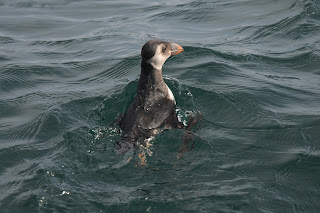
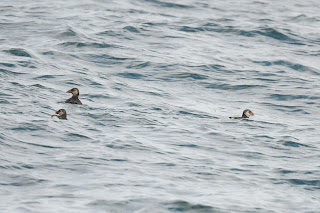
About ten miles out we really started getting some puffins.  We saw groups of three, four, and five at a time, and they were very approachable.  Last winter we saw a lot of Dovekies but did not see many puffins, so it was nice to find such large numbers.  
Our gull and gannet flock continued in force as we moseyed offshore and about 25 miles out the water warmed slightly.  Inshore we had temps in the mid 40s, but we found a slight temperature break from about 50 to 55 degrees in 24 fathoms.  Apparently this was warm enough for Atlantic Spotted Dolphins, and we had great looks at a couple dozen of these acrobatic dolphins that came charging in to bow ride.  We also saw a couple lethargic, large Loggerhead Turtles around here as well as a handful of Black-legged Kittiwakes and Manx Shearwaters.

The forecast was calling for quite a bit more wind and some rain in the afternoon, so we headed back toward the inlet a little early.  The trek back was again productive for puffins and we had excellent looks at a Common Murre on the water beside the boat and also a young kittiwake.  Closer to the inlet we found hundreds of Razorbills flying north and a couple more Manx Shearwaters.  We had good conditions crossing the bar and we made it back to the dock before the rain really set in.

Once again the winter waters off the Outer Banks provided us a remarkable bounty of seabirds fairly close to shore - less than half the distance we would have to travel off the Virginia Capes where we ran the majority of our winter trips for the first 15 years.  Down here, it's often action-packed from start to finish once the water gets cold.  Looking forward to getting back out there this weekend.  ~ Brian Patteson

Thanks so much to everyone who made it possible for us to get offshore for this trip and a huge "Thank You" to Jonathan Cooley for helping us lead the trip on short notice!  Photos today by Kate Sutherland.

Species List for February 7, 2022

Razorbill - 569
Common Murre - 5
large alcid - 19
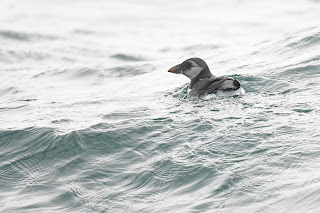
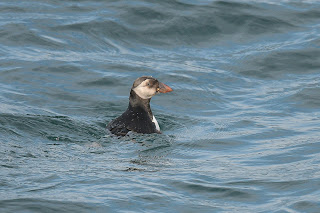
Atlantic Puffin - 166 (careful count, new record, mostly immatures with a few adults)
Black-legged Kittiwake - 7 (at least one adult, at least four immatures)
Bonaparte's Gull - 48
Little Gull - 2 adults
Ring-billed Gull - 1
Herring Gull - 97 to 112
Great Black-backed Gull - 22
Forster's Tern - 7
Red-throated Loon - 14
Common Loon - 3
Manx Shearwater - 10
Northern Gannet - 154

Atlantic Spotted Dolphin - about 25
Loggerhead Turtle - 2

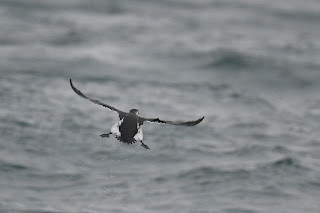
Our first Common Murre was on the water on the wet side of the boat and took off before we were able to see it well!
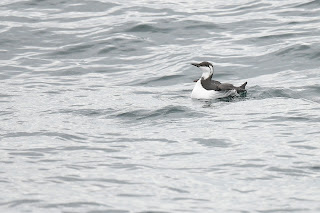
On our inshore tack we had a much more cooperative individual.
The Atlantic Puffins!  They were just super cooperative - all of these images are of immature individuals, but we did also see some adults.
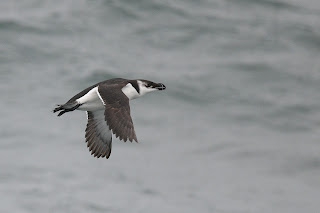
One of the afternoon's Razorbills
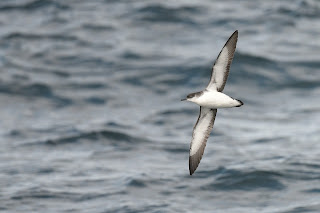
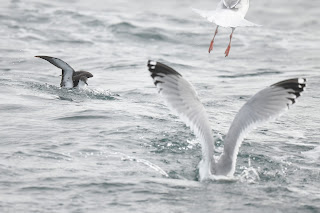
Manx Shearwaters were feeding behind the boat with the gulls, it was awesome to have these small black and white shearwaters passing so close behind us!
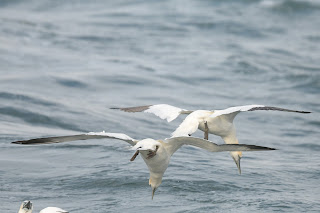
Northern Gannets are always a joy to see, we don't always have them following the boat so this was a treat.  This first photo followed the one in the text!
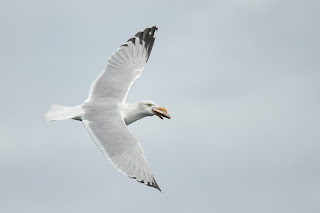
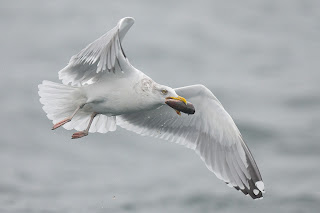
One of our happy Herring Gulls with a Menhaden head we so lovingly chopped up for it before the trip.
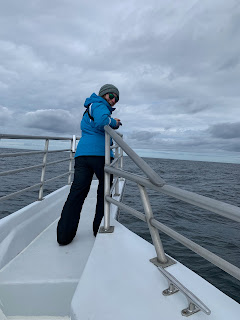
And participant April Harper from Culpeper, Virginia watching Atlantic Spotted Dolphins from the pulpit!  The best place to be when they start bow riding.
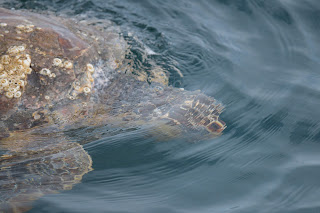
One of the Loggerhead Turtles

Saturday, January 8, 2022

The Cahow Experience 2021 ~ by Kate Sutherland

As we move into 2022 we all can use some good news, especially on the conservation front and even more so on a seabird front!  The Bermuda Petrel (Pterodroma cahow), or Cahow as it is locally known, checks all of these boxes for us.  For those of you unfamiliar with this species, though if you're reading this blog you must have seen them mentioned before, the Cahow is what is called a Lazarus species.  A species that was once thought extinct, in this example for over 400 years, that is rediscovered.  In the case of the Cahow, it was just hanging on to existence when rediscovered in 1951 with seven burrows occupied.  Now seabirds are generally speaking long lived species, so it would not be impossible for them to go unnoticed for long periods of time especially when nesting in places humans do not frequent.  Dr. David Wingate was integral to the survival of this species, monitoring all nesting activity, creating new, artificial burrows to increase the population, removing rats from nesting islets, discovering that the White-tailed Tropicbird posed a threat to chicks and thwarting their entrance to burrows, taking the fight over DDT to the courts in the US, and taking Nonsuch Island in Castle Harbor back to its natural state.  In general, rescuing this species from the brink.  In 2000 current Chief Conservation Officer Jeremy Madeiros took over from David, having been his protege for many years, and began his own chapter in the story of the Cahow.  He carried on with David's work and added another layer - interacting with the birds by banding them, weighing and measuring them, and initiating a translocation program that took chicks from the smaller, low lying islets and moving them into a colony on Nonsuch Island which until this point had no nesting Cahows.  This program began in 2004 and presently there are two translocation colonies on Nonsuch Island which now hosts the second largest colony in Bermuda with over 30 nesting pairs!

In 2011 Dr. Robert Flood (Bob), organizer of the Cahow Experience, planned a trip to Bermuda to research the Cahow for his upcoming Pterodroma Petrel guide.  Keen seabirder Hadoram Shirihai joined him on this expedition as well.  That year they chartered a small dive boat to go to sea six times (photo below).  Bob was able to visit Nonsuch with Jeremy, yet left feeling like he needed more time at sea with these gadfly petrels.  He was able to organize another research trip the following year in 2012, again chartering a small dive boat and heading to sea eight times (photo below).  All but one of these trips registered only single digit Cahow sightings, and of those only a handful were even close!  Maximum seen on the 2012 trip was 10.  Again Bob was able to join Jeremy on Nonsuch for banding studies and see the nesting Cahows in the hand.  He had a number of people express interest in joining him to search for these rare seabirds in Bermuda so in 2013 he organized a small group.  That year the most seen on one trip was six Cahows.  I read about these trips on a seabird news group in 2014 and planned to join in 2015.  Having worked for Seabirding for almost 15 years by that time, I had seen a number of Bermuda Petrels, or Cahows, offshore from Hatteras, NC but the chance to see them where they nest was irresistible.  Not only did we see a number of Cahows at sea that year but we also had the first photographed Trindade Petrel for Bermuda on one of the trips!  Seeing these birds in the hand and learning about them first hand from David and Jeremy was life changing.  And to smell a Cahow?  Well, I was hooked!  Bob invited me to help him lead the tour in 2016 and the rest is history.  We had groups join us in 2017 and 2018 then we were unable to make it a go in 2019, and November 2020?  Well, you might suspect why that didn't run!!  So we were super excited to get back there this past November for another look at the Cahows and offer people the best opportunities in the world to photograph them and learn their story from the men who created it.

Our first inkling that this year would be different than all before came on Tuesday November 9, 2021 when, standing at Cooper's Point, we tallied FIFTY-ONE Cahows in view at once!  Yes, a jaw dropping number from our high count of 20 offshore in 2018.  Our first trip offshore aboard the R/V Endurance (photos below), the Bermuda Museum Aquarium and Zoo's vessel, found between 30 and 50 individuals!  During the 2020-2021 nesting season there were a total of 26 nesting pairs on Nonsuch, when we visited the island on November 12, 2021 Jeremy informed us that the 2021-2022 season has over 40 as I mentioned earlier!  As the population of this endangered petrel grows so does our knowledge about their natural behaviors.  When I first began visiting Bermuda six years ago the general idea was that the birds we saw offshore were younger, non-breeding individuals and that adults returned directly to their burrows.  I photographed some individuals that had dirt on their abdomens in 2018, this, Jeremy told me, was a result of burrowing or coming and going from a burrow.  So were these young birds just prospecting?  As it turns out, adults and younger birds make up the individuals we see courting and flying together offshore from Castle Harbor!  Jeremy now knows that these birds will be flying, calling, and courting near the translocation colony and then return to their burrows when he is on night watch.  When you ponder it, it makes sense that just a few birds who have never known life with hundreds or thousands of individuals might not exhibit the natural behavior expected from a large colony.

There were a number of firsts on this trip.  We had the highest counts of Cahow recorded since the 1600s and Jeremy Madeiros himself joined us for our final trip to sea (photo below)!  This final trip offshore gave us the closest looks yet at these gorgeous gadflies.  At least 50 Cahows were seen on November 16, some of which came right to the boat hovering close by before zipping away.  It was almost as if they could smell their keeper on the boat with us.  Those of you who are addicted to seabirds, more specifically tubenoses, like I am know that their sense of smell is unrivaled.  I like to imagine they could smell their strange looking companion who handles them at least once a year.  The creature who for some was their surrogate parent who fed them in the translocation colony.  How curious for them to smell, or hear him, at sea!  Regardless of the reason, the last trip was epic.  An adult White-tailed Tropicbird flew right over us as well to investigate, and while I hear that they are in the area during the fall and winter months, this was the first time these trips had recorded one that was not a rehabbed youngster being released.

Our final evening in Bermuda, November 18th, Bob was able to organize a night watch for myself and Peter Flood (no relation to Bob) with Jeremy.  Unfortunately the moon was just about full, but Jeremy thought perhaps if the cloud cover remained we might see a bird or two.  Another behavioral assumption shattered!  We had over six birds at once flying around us near the translocation colony there on Nonsuch Island just after dusk!!  They were courting and calling and we could clearly see them as they flew in the light of the full moon!  As we left that evening Jeremy said, "if we have a moment, humor me!  I'd like to check something out!"  We pulled up to Horn Rock (photo below), the islet with the largest nesting colony at over 40 pairs, and just as we neared a Cahow flew right by us!  Jeremy cut the engine and we sat observing the islet.  It was like a beehive of activity!!  Durning the full moon!  Who would have imagined?

Bob Flood and I will be heading to Bermuda again in 2022.  These trips are not traditional birding tours, but we offer the chance to take four trips offshore and to visit Nonsuch Island with Jeremy Madeiros to observe the Cahows in the hand as he checks nesting pairs to begin the season.  There is also the chance to go birding around Bermuda where a number of Nearctic species are possible.  In November 2021 our participants logged a number of wood warblers including Blue-winged, Black-throated Blue, Black and White, Tennessee, Blackpoll, Orange Crowned Warblers and more!  The endemic White-eyed Vireo can also be easily seen on land.  One of the locals in Bermuda, Lynn Thorne, organizes birding tours and will take people to some of the more productive locations for a donation towards her Wildlife Rehabilitation and Sanctuary.  If anyone is interested in joining us for this 2022 seabird adventure, contact Robert Flood - live2seabird@gmail.com - or myself (Kate Sutherland) - cahow1101@gmail.com

Thanks for reading!  Check out some images from Robert Flood's research trips and some of my photos from our 2021 Cahow Experience below ~Kate Sutherland, Seabirding, Hatteras, NC USA

Additional posts about the Cahow Experience can be found here:

Check out the Cahow Cam which has live footage from two of the burrows in one of the translocation colonies on Nonsuch Island!  http://www.nonsuchisland.com/live-cahow-cam  These cameras were the brainchild of Jean-Pierre Rouja, founder of Nonsuch Expeditions and the man behind the camera for Jeremy's updates.  Our group was lucky to have him with us on our visit to Nonsuch Island in 2021 (photo below).

First research trip in 2011 - pictured below Robert Flood (center), David Wingate (right), and Hadoram Shirahi (left)
Vessel used for the 2012 research trips - pictured below Robert Flood (left), David Wingate (center), Mike Danzenbaker (right)
The R/V Endurance owned and operated by the Bermuda Museum Aquarium and Zoo (BAMZ).  This is the vessel we currently use for the Cahow Experience at sea trips!
A handful of images from the 2021 tour taken at sea.  All taken by myself, Kate Sutherland.


And a few photos that I took while visiting the colony:


Horn Rock, the site of the largest nesting colony with 47 pairs this season (2021-2022)!!
Another view of the R/V Endurance as we headed to Nonsuch with Jeremy, Captain Nigel Pollard and First Mate Chris Burville.
2021 participant Graham Gerdeman taking video on our approach to Nonsuch Island
David Wingate (left) with Robert Flood (right), participant Nick Robinson is in the background.
Jeremy Madeiros (center) with Robert Flood (left) and Peter Flood (right)
Scanning for Cahows aboard the R/V Endurance with David Wingate
A panoramic photo taken by Jean-Pierre Rouja of our group on Nonsuch Island 12 November 2021.  Copyright J-P Rouja
And a still image taken from the surface cam also run by J-P Rouja in addition to the burrow cams from the full moon night watch 18 November 2021!
Tuesday, January 4, 2022

Friday December 31, 2021 - Searching for Skuas - Kate Sutherland

Our final trip of the year was scheduled for December 29 with a weather date of the 30th, but as the date approached, the weather foiled our plans and it looked like the only day that would be manageable was Friday December 31...so we checked with those who had signed up and most were willing to go during the small window of opportunity.  We even garnered a little more support from our loyal NC birders!  The water offshore of Hatteras is still pretty warm and even north of Cape Hatteras the temperatures are in the mid 50s.  It seems winter weather comes a bit later every year for us and the winter species with it.  But we've found some good birds out there in December in the past and Great Skuas are likely around somewhere...so always worth a look for our Big Year birders!  This trip however, was a bit slow on the bird front and the only pelagic species we turned up were a nice flock of Red Phalaropes, a totally unexpected Black-capped Petrel, and a Manx Shearwater.  The gulls and gannets were quite cooperative in the chum and we had all age classes of Northern Gannet plus six species of gull.  

After leaving Hatteras Inlet just after sunrise we decided to steam offshore, heading to Diamond Shoals Light Tower, then we headed north about 12 to 15 miles offshore of Hatteras Island - prime Great Skua territory!  There was a gorgeous blue / green color change just north of the light tower and this was where we found the Red Phalaropes. 
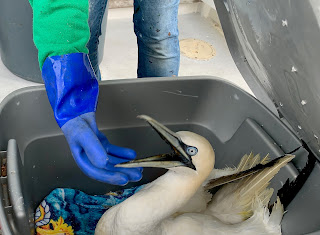
Hatteras local, Haley Rosell, brought a Northern Gannet with her that she had in rehab for a few days.  It had a sprained wing, but with medicine and rest she decided it was ready to go and wanted to get it out with us if possible.  She gave it the opportunity to return to life offshore on that same color change! 
It was so cool to see one of these birds up close - they seem to be made of porcelain with indescribable colors around the eyes and on the tops of the feet.  This also happened to be where fog settled in around us...  Unfortunately fog makes birding difficult at best and we had to deal with it for a couple of hours.  

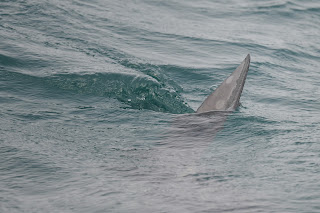
Life in the water was bountiful and we encountered some playful, young Atlantic Spotted Dolphins, some hammerhead sharks, at least two large Loggerhead Turtles, and one very cooperative Ocean Sunfish (aka Mola mola)
all north of Diamond Shoals.  As we approached the shoals nearshore for our trek back to Hatteras Inlet, Jamie Adams spotted a distant Black-capped Petrel!!  Just 6 miles off the beach!  WOW!  You just never know what you'll see - what a nice new year's eve gift for us!  Back south of the shoals we found that one distant Manx Shearwater.  While our search for the Great Skua was unsuccessful (we covered all of the places we've seen them in the past), it was a nice day out there and we were able to eke out a list in spite of the unseasonably warm December weather!

Thanks to everyone who changed their plans around to still make it offshore with us even though we had to change the trip date, it was a great way to end the year and the season!  A huge thank you also to Ed Corey and Steve Backus for helping Brian and I lead the trip - we'll see you in 2022!
(All photos today are by Kate Sutherland)

Species List for December 31, 2021

Black-capped Petrel - 1
Manx Shearwater - 1
Red Phalarope - 25 to 30

Northern Shoveler - 4
American Wigeon - 2
Northern Pintail - 18
duck species - about 20
Surf Scoter - 3
Surf / Black Scoter - 20 +
Long-tailed Duck - 2
Bonaparte's Gull - 10
Laughing Gull - 27
Herring Gull - 154
Lesser Black-backed Gull - 9
Great Black-backed Gull - 17
Royal Tern - 2
Common Loon - 8
Northern Gannet - 64
Brown Pelican - 1

Bottlenose Dolphin - 23 to 25
Atlantic Spotted Dolphin - 4 to 6
Loggerhead Turtle - 2
Hammerhead Shark (scalloped or Carolina) - 5
Spinner Shark - 1
shark species - 1
Ocean Sunfish (Mola mola) - 1

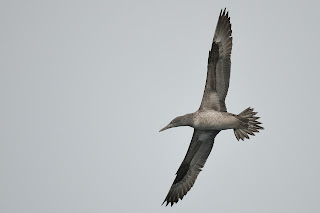
Young Northern Gannet, this bird fledged earlier this year!
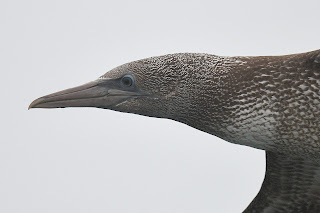
And a close up of the gorgeous facial features of a juvenile gannet
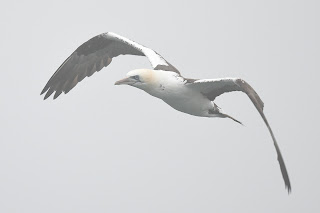
A third winter Northern Gannet in the fog...
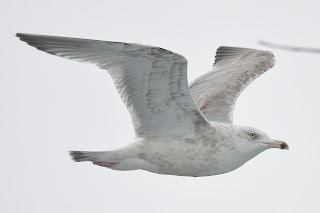
A selection of Herring Gulls, second winter:
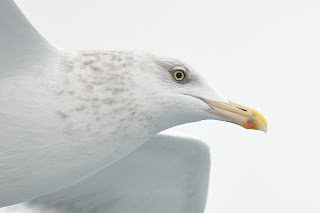
Gorgeous eye of an adult
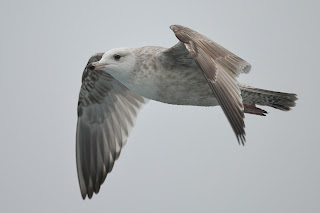
A darker second winter individual
An adult with a Menhaden head!
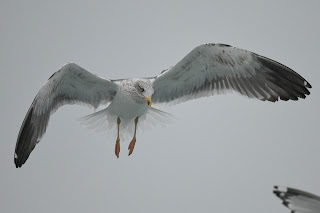
One of the Lesser Black-backed Gulls that was following us as we approached the inlet in the afternoon

Sunday, October 31, 2021

Saturday October 23, 2021 - Final Fall Outing! ~ Kate Sutherland

Skies were overcast as we met at the Stormy Petrel II (late) Saturday morning.  Myrtle Warblers were eating bugs in the lights at the marina and we could hear them overhead.  Since the sun it so late to rise in the fall we didn't meet until 06:30, but by the time we made it to Hatteras Inlet, the sun was peeking out of the clouds and we headed offshore in choppy seas left from the wind the night before.  Winds were light from the north west and we found some shearwaters on the shelf in addition to cooperative Atlantic Spotted Dolphins!  The shearwater flock we encountered had both Cory's and Scopoli's (pictured below)
in attendance plus a few Great Shearwaters.  For many of our participants this was their first encounter with these species.  A Pomarine Jaeger also flew by on the shelf, passing closely by ahead of the boat it gave some nice views but there was no catching it!   
Just beyond the shelf break around 10:00 we found more shearwaters!  It was also here that we began to pick up some Wilson's Storm-Petrels.  We don't always see them at this time of year, so having over a dozen with us for most of our time offshore was spectacular!  They came close each time we circled back on the slick offshore and everyone had nice views of these small stormies from the Southern Ocean. 
It was awhile before we saw our first Black-capped Petrel of the day, but once we found them they were very obliging.  A short time later our first Pomarine Jaeger started following us in the slick, soon to be joined by another!  Both looked to be near adult or adult birds, one still had a long, though tattered, tail streamer. 
The Black-capped Petrels put on a nice show dogging these Poms and watching their incredible, acrobatic flight kept most of us in the stern content for hours (yes, the Poms were with us for over two hours!).  Audubon's Shearwaters were a bit difficult to see well, but nearshore at the end of the day we found one with a nice flock of Cory's, Scopoli's, and Greats that sat long enough for everyone to see it well!  There is a lot of variation in Audubon's Shearwaters, especially in the facial and underwing patterns.  Perhaps one day we will have more information about some of the different nesting populations of Audubon's in the Caribbean and we'll be able to tell more about the light form and dark form birds like we do for our Black-cappeds.  
Also of note offshore were the many Yellow-rumped (Myrtle) Warblers, a high flying flock of Great Blue Herons, and a young Lesser Black-backed Gull.  Thanks so much to everyone who joined us out there for our final trip of the fall, and a huge "Thank You" to all of our supporters this year!  Thank you also to Steve Backus for helping Brian and I lead this trip.  Our 2022 Schedule will be up later this fall!  ~Kate Sutherland (all photos today are mine)

Species List for October 23, 2021
Black-capped Petrel - 19 to 21
Cory's Shearwater - 7
Scopoli's Shearwater - 17
Cory's / Scopoli's Shearwater - 255
Great Shearwater - 20 to 21
Audubon's Shearwater - 5
Wilson's Storm-Petrel - 34
Pomarine Jaeger - 4
jaeger sp. - 2
Common Tern - 2
Lesser Black-backed Gull - 1
Great Blue Heron - 5
Yellow-rumped (Myrtle) Warbler - 21 to 22
Atlantic Spotted Dolphin - 12 to 15
Bottlenose Dolphin - 42 to 52
Monarch - 1

A few Black-capped Petrel images, always a crowd pleaser, and certainly one of my favorite seabirds!
Cory's Shearwater - nice ventral and dorsal view of one individual that we saw

Another Scopoli's ventral view:
And a Cory's type shearwater.  A number of birds we see have some white in p8, 9, and 10 but not 20% or more.  These could be Cory's?  Or poorly marked Scopoli's?  I just leave them as Cory's / Scopoli's!
Great Shearwaters were also cooperative!
An interesting view of a Wilson's Storm-Petrel
Our other Pomarine Jaeger
And finally a couple of the offshore Bottlenose Dolphins we saw!