Monday, December 7, 2015

Saturday December 5, 2015 - Virginia

Participants started showing up at Dockside at 0530, excited by the opportunity to get offshore from Virginia in December and see what we could find out there.  The weather held off and while it was breezy on Friday, the wind fell out enough for us to head out at 0622 Saturday morning.  The sunrise was spectacular and was just the beginning of a very mild, sunny day offshore (photo by Kate Sutherland).
Just over an hour later we had a Parasitic Jaeger put on a nice show chasing a gull, nice start to the day!  While we were unable to entice many birds to follow us, we did see some Northern Gannets (photo below by Kate Sutherland) & gulls on the way out to deeper water.
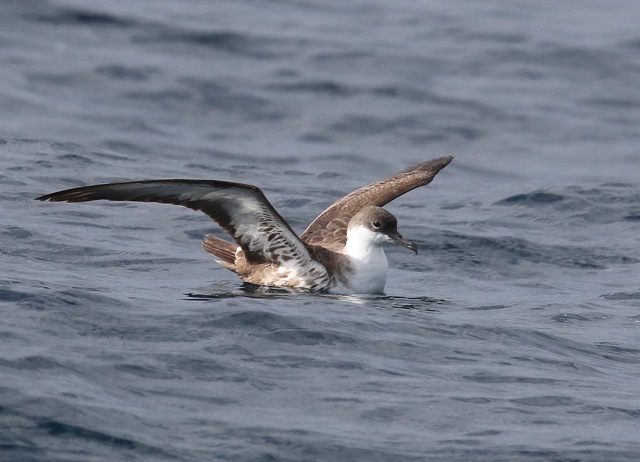
The wind was blowing about 10-15 from the north making the ride to deeper water a little choppy, but we did see some nice flocks of Bonaparte's Gulls on the way out, a good sign!  We passed some very obliging Common Loons on the water and even saw a Great Blue Heron on the way out as well.  Brian had seen a nice temperature change offshore about 50 miles out, so we continued that way.  Around 1045, in a little over 120 feet of water, there was some activity ahead and the water looked a little different, it was warmer and we even found a few pieces of sargassum out there.  The first tubenose of the day was a Northern Fulmar, followed by a Great Shearwater (photo by Brian Patteson)!
We had excellent views of each of these species as they followed us feeding on chum with the gulls and gannets that comprised our flock.  Northern Fulmar with Herring Gulls (photo by Kate Sutherland)
It was after 1130 before we had our first good view of a Black-legged Kittiwake, but just a few hours later we had multiple individuals following the boat flying right up behind us!  At one point we had a young kittiwake (photo below by Brian Patteson)
sitting on the water with a Northern Fulmar!  Red Phalaropes were out there too, but we just had some individuals quickly fly by, none were cooperative enough to land on the water for approach.  As we headed back inshore, the wind breezed up, but it was much easier birding with the waves behind us and we approached several flocks of Bonaparte's Gulls for perusal (no Little Gulls were discovered!).  One such flock was over some feeding Little Tunnys and were calling as they constantly shifted position over their moveable feast.
These small gulls were definitely the dominant species offshore on Saturday with numbers nearing 12,000!  The water off of Virginia is still quite warm, in the high 50s, so it was not too surprising to not see good numbers of alcids on this trip, but we were lucky to have two Razorbills fly by close enough for everyone to get nice views!

Thank you so much to everyone who joined us for this first trip of five from Virginia Beach!  A big thank you also to Ned Brinkley & Todd Day who helped us lead this trip.  Next weekend is full, but we still have space on all of our January trips.

We saw Northern Gannets, Great Black-backed Gull, Herring Gull, Ring-billed Gull, Laughing Gull, Bonaparte's Gull (several thousand), and Lesser Black-backed Gull (nearshore).  We also encountered Red-throated & Common Loons plus one Great Blue Heron.  -Kate Sutherland

Northern Fulmar  10
Great Shearwater  3
Red Phalarope  10
Black-legged Kittiwake  14
Parasitic Jaeger  1
Razorbill  2
alcid sp  1
sea turtle sp  1

 Northern Fulmar (all photos below by Kate Sutherland)
Northern Gannet
Herring Gull (first winter)

A few photos of Black-legged Kittiwakes, all young birds
As we neared Cape Henry, we were treated to a spectacular sunset!!

Sunday, November 22, 2015

Bermuda 1993 - by Brian Patteson

Kate Sutherland, myself, and several others spent a week and a half in Bermuda earlier this month for the purpose of observing and photographing their endemic seabird, Pterodroma cahow the Bermuda Petrel as we know it, or the Cahow as it is called by Bermudians. We had a very successful trip and saw a great many Cahows, both at sea and ashore at their colonies. We saw more Cahows in an afternoon than we have seen at sea off North Carolina in the last decade, and far more than I saw on my first trip to Bermuda in 1993.

The 1993 expedition to study Cahows was the result of two sightings of Bermuda Petrels off the U.S. southeast coast on July 31, 1993. Ned Brinkley and I saw one off Oregon Inlet that day and Todd Hass and Joe Poston saw one over 200 miles off Charleston the same day. Ned and Todd and I spent a lot of time at sea together in those days. Todd was working on a PhD at UNC and he was on almost all of the pelagic bird watching trips in NC at the time, gathering data for his dissertation. We all wanted to know how better to identify these petrels at sea, and at the time, information was scant. In stark contrast to today, there were almost no photos or good illustrations of live Cahows. Comparative morphometric data was also lacking. We had an idea how the species differed from Black-capped Petrel, but just how much smaller it was and how much darker was not something you could find in print, which was the media of bird identification at the time.

Ned began corresponding with David Wingate in Bermuda and before long, we had plans to visit Bermuda and study Cahows. Things were a bit different back then. There were only 40 or so pairs and Wingate, who had brought them back from near extinction, did not band or regularly handle the birds. We did get to see an adult in a burrow during a nest check with him, but he did not extract it. We also made history with the first daytime sighting of a Cahow in recent history during a boat trip off the east end of Bermuda on Nov. 13, 1993. It was much harder to get photos of flying seabirds back then (manual focus and film days) and we did not get a record shot. For our ID studies, we photographed all of the specimens at the museum.  We also made a nighttime trip to Horn Rock where we had birds whizzing overhead and we recorded their calls. Upon return to the States, we began working on an ID article for Birding magazine. Wingate supplied a few recent photos of live birds in hand and as luck would have it, we found another Bermuda Petrel off Hatteras in May 1996 and I got some photos of that one good enough to publish (they suck by today’s standards, but they were the first of the species at sea.) The article was finally published in the Feb. 1998 issue of Birding, and naturally in spring 1998, I got better photos.

Things have changed a lot since that first trip. There are now over 100 pairs of Cahows and they now nest on Nonsuch Island where we stayed with Wingate in 1993. Jeremy Madeiros, who took over Wingate’s work after his retirement several years ago, now bands the birds and has also done tracking studies, which explain why they are seldom seen here with the Black-capped Petrels off Hatteras. But it is easier than ever to see Cahows in Bermudian waters as a large troop of sub adults spend weeks courting and prospecting for nests during fall and winter. They can be seen from Cooper’s Point, which was formerly a restricted area, but they are better seen from a boat just a few miles offshore.

Our 1993 trip was important for number of reasons. It helped us work out the field ID of the species and disseminate that information. It got Wingate and other Bermudians out looking for Cahows at sea during the breeding season. It inspired Brinkley to return several times with birding tour groups, thus getting more birders interested in the petrel and the place. And most importantly, it was on that trip that got to know and spend a lot of time with David Wingate, and then that we first met Jeremy Madeiros, who has taken charge of the Cahow program in the 21st century and is not only continuing Wingate's work, but helping us learn more about the secret life of these special seabirds.

by, Brian Patteson - 22 November 2015 (all photos copyright Brian Patteson)

On the porch at Nonsuch: David Wingate (left), Todd Hass (right)

Ned Brinkley & David Wingate

Boat trip on November 13, 1993: David Wingate explains the game plan

Ned contemplates the trip ahead of us.

Todd looks like he is ready for some water to cross the deck

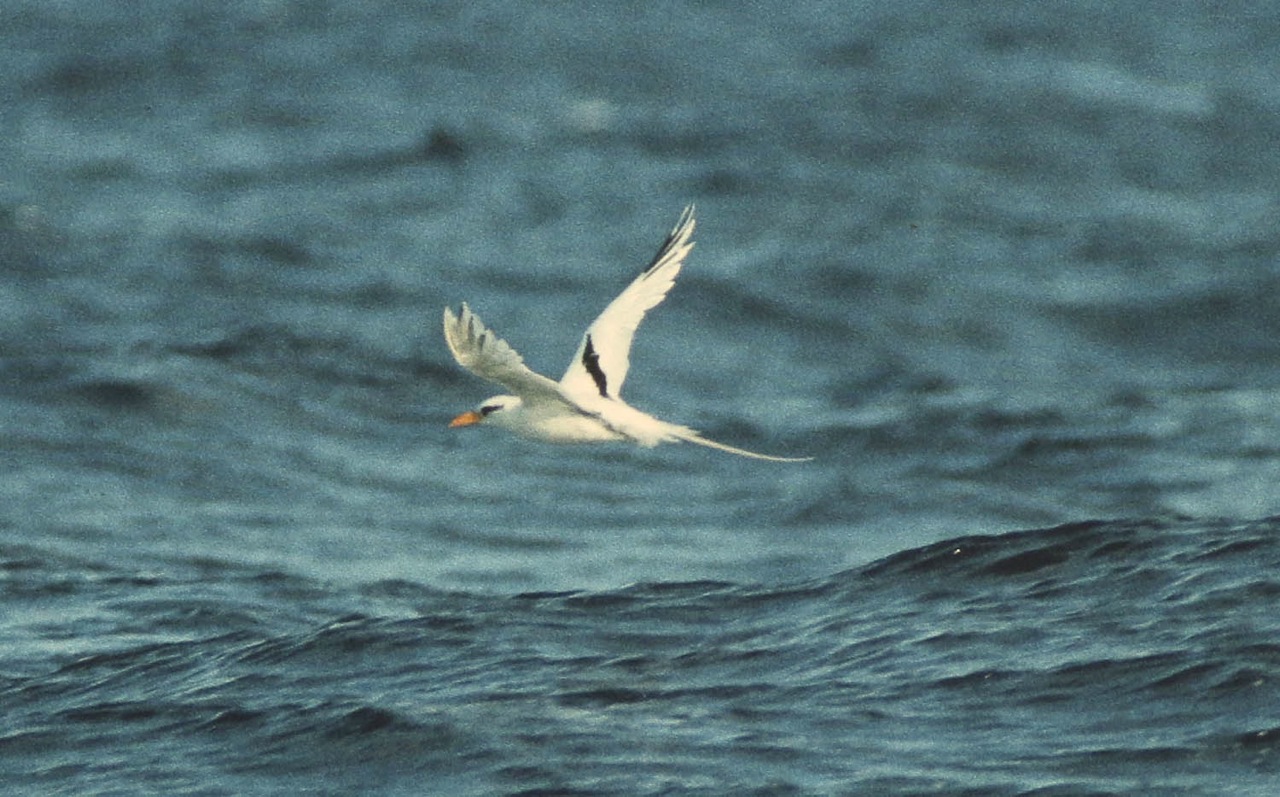
No pics of the Cahow we saw, but a late tropicbird came by within camera range

Wingate moors his Boston Whaler at Nonsuch

Checking Cahow nests for activity on Horn Rock

Not enough light to see the adult Cahow inside

Cahow nests on Horn Rock

Entrances to Cahow burrows

Looking over to Cooper's Point, which was off limits at the time.  It is now a great vantage point for seeing Cahows in late afternoon during the breeding season.

Adult and young Cahow specimens

Studying the dorsal aspect of the Cahow and its gray-tipped upper tail coverts (white in Black-capped Petrel)

Studying the ventral aspect of the Cahow and its cowled appearance

No place now for live Cahows on mainland Bermuda

Carnage from the Snowy Owl that visited in 1987

Pelagic trip!  Setting out in a leaky Boston Whaler

Leach's Storm-Petrel as seen from Wingate's Boston Whaler.  We also saw Cuvier's Beaked Whales!

Birding ashore: I think these flamingos were at Spittle Pond

Sandhill Crane at the dairy

Looking out from the porch at Nonsuch

Sunday, October 11, 2015

Saturday October 10, 2015 - by Brian Patteson

It was good to be back offshore with a birding trip after a rainy and windy two weeks here at Cape Hatteras. Dr. Fred Alsop brought his Coastal Ecology Class to the Outer Banks for a field trip that has been a tradition for 35 years. We’ve been taking Fred’s group on pelagic trips since 1994 when I started organizing trips in Hatteras. We also had a handful of other birders along, including stalwart regulars and new participants.

The forecast called for a rainy day, but it turned out not to be the case, as the rain came much later than predicted, beginning soon after we returned to the dock. The morning was beautiful with light westerly winds and smooth seas. We left the dock at first light and enjoyed an easy ride to the Gulf Stream, which we found near the shelf break about 23 miles out. There was a distinct color change where the clear blue water met the rather murky inshore water. This is not always the case in October, but we’ve had so much rain and wind that I expect it will take a while for the shelf water to clear up. We did not find much bird activity near this color change, but we did have a quick look at a Leatherback Turtle which we startled as we arrived at the edge.

I figured there would be at least a few Black-capped Petrels out in the deeper water, so we eased out toward the slope waters right away. Approaching 200 fathoms we saw a distant Black-cap and we increased our chumming effort by melting a homemade chum block. Within minutes we had Black-caps close at hand and a Northern Fulmar also came in and gave us good looks (photo by Brian Patteson).
There has been a strong showing of fulmars in New England already, so it was not a big surprise, but we usually don’t get them quite so early here. We continued to work offshore, but all we came up with were a few Cory’s and Audubon’s Shearwaters. There was not much Sargassum, so it’s not surprising that Audubon’s were hard to find, but Cory’s were remarkably scarce for a fall day.

After a while, it seemed like most of the Black-capped Petrels were fading behind us, so we backtracked inshore. The wind also freshened and we soon had quite a following of Black-caps, with up to 20 in view.
They followed us in close to the edge of the Gulf Stream, which was in about 75 fathoms when we crossed in the afternoon. But before we left the blue water we stopped to sample the Sargassum with a dip net. Compared to late summer, the “Gulf Weed” was in short supply. We did not get any fish in our sample, but we had the usual shrimp and crabs. The highlight, however, were some Sargassum Nudibranchs- little gastropods that look just like the habitat they live in.
A Great Shearwater came by for a close pass, as we were getting ready to head back to shore. The ride back in the dirty water was uneventful as expected, but the trip to the Gulf Stream had been well worth it and hopefully it will inspire some of its first time visitors to return there someday.


I would like to thank all of our participants,-especially Fred for bring his class, and our leaders- Kate Sutherland, Jeff Lemons, and Kyle Kittelberger for making this a successful trip.

Trip List:
Common Loon  2
Northern Fulmar  1
Black-capped Petrel  50-70
Cory's Shearwater  16
Great Shearwater  2
Audubon's Shearwater  5
jaeger sp.  2-3

Great Blue Heron  1
Blue-winged Teal  13
American Pipit  1

Leatherback Turtle  1
Inshore Bottlenose Dolphin  30-40
marlin sp.  1

A few more images of the ever impressive Black-capped Petrel:
top photo by Brian Patteson
A Scopoli's Shearwater (nominate Cory's):
A photo of the Great Blue Heron, zoomed in!
& one more of the Sargassum Nudibrachs, such cool little creatures!
 A couple of ships we crossed paths with over the course of the day...

Tuesday, September 8, 2015

Sunday September 6, 2015

We had scheduled a couple of trips on the F/V Skua for this past weekend, but in keeping with weather patterns of late, we had northeast winds predicted for both Saturday & Sunday.  Saturday morning the weather buoy at Diamond Shoals showed the wind blowing strongly and steadily from the northeast with very steep waves, a bit too much for the biggest little boat in the harbor!  Brian met our participants at the dock to fill them in and let them know that Sunday would hopefully go, as it was forecast to be a bit calmer.  Luckily it was, and I headed out with Capt. Will Whitley and a full boat at 0617 on the 6th.  Brian had a conflict with a fishing trip scheduled on the Stormy Petrel II, so he did not join us.  It was strange to see her behind us in the morning as the sun rose (she's on the left)!
The ocean was much calmer than anticipated, though we knew it was windier offshore, and that in the Gulf Stream current the wind would make our ride a little wilder!  Just after 0830 we slowed down for a group of Red-necked Phalaropes concentrated by a nice line of sargassum
and also saw some Audubon's & Cory's Shearwaters there.  Will spotted a current edge up ahead and when we reached it, the temperature went up 2.5 degrees Fahrenheit, with the Gulf Stream moving at about 1.2 knots on the far side.  I knew we were in a good place when we saw a jaeger ahead chasing some Bridled Terns - a Long-tailed I thought just from watching its behavior and taking note of its size and shape.  The photos I snapped were not the best, but it was identifiable as a juvenile individual.
This was a nice place to spend some time, so before we headed offshore to deeper water, we cruised along the sargassum and found some more Bridled Terns, adults with their attendant young.  There were two perched on a piece of flotsam, the adult paying little attention to its very vocal companion!
Wilson's Storm-Petrels were slow to gather in the slick when we put out our oil slick around 100 fathoms.  Their numbers begin to thin out in late August and September, so I was glad to see as many as we did!  And while Band-rumpeds are not unheard of in September, careful examination and scanning did not reveal any on Sunday.  Our first close shearwater was a Sooty that ignored our chum and continued by to the southeast, but, as if to make up for it, we had two very cooperative Great Shearwaters come right in to the stern where they spent time feeding and diving!  Out over the edge of the shelf we finally picked up our first Black-capped Petrel just before 1130 and we had excellent views of this amazing seabird in the slick for most of the afternoon.  
Audubon's Shearwaters were by far the most abundant shearwater of the day and we were able to approach them on the water, and they us in flight.  We had a young Herring Gull that came in shortly after 1100 staying with us in the slick for the rest of the day, and even following for awhile after we picked up for the run back to the inlet!  Two second summer Pomarine Jaegers visited the slick, one just after 1130 and the other closer to 1400, a nice treat after the quick glimpse of the first jaeger in the morning!
Overall it was an awesome day out there, in spite of, or perhaps because of, the wind and the Gulf Stream current!  Thanks to everyone who joined us offshore, and a big thank you also to Capt. Will Whitley for doing an excellent job piloting the boat all day!  - Kate Sutherland

Trip List
Black-capped Petrel  13-16
Cory's Shearwater  26
Great Shearwater  9
Sooty Shearwater  1
Audubon's Shearwater  59
Wilson's Storm-Petrel  40-50
Red-necked Phalarope  28
Bridled Tern  10
Black Tern  40
Pomarine Jaeger  2
Long-tailed Jaeger  1

Herring Gull  1
Sandwich Tern  1

Flyingfish seen: Atlantic Patchwing, Atlantic Necromancer, Oddspot Midget, Sargassum Midget, & possibly some Purple Bandwings

Cory's Shearwater (all photos today by Kate Sutherland!)
Great Shearwater
 Wilson's Storm-Petrel
One of the young Bridled Terns seen in the morning
& another take on one of the youngsters