Almost ten years have passed since we had the pleasure of running some trips "up the beach" in the summertime. Our winter trips regularly leave from Wanchese and head out of Oregon Inlet now with Hatteras Inlet as our secondary departure location, or weather port. As I mentioned in a previous post the water to the north can be quite different to what we have offshore from Hatteras in August! Our planned "blitz" was to run from 22 August daily through the 31st - ten trips. We already knew looking at the long range forecast that it might not happen, but we were determined to do what we could.
The first trip on the 22nd confirmed that we made the right decision with birds on the shelf, including a super cooperative group of Red-necked Phalaropes (Kate Sutherland),  Cory's, Scopoli's, and Great Shearwaters plus some Black Terns and Wilson's Storm-Petrels! This shelf life continued for most of the trips we had. There is so much more flexibility up here at this time of year with cooler water typically inshore and the hot fast water offshore - we found nice temperature breaks on most of the trips we ran. Some days we had very swift current offshore and other days not too much. So we ran the first trip on the 22nd and had to cancel the trip on the 23rd due to forecasted high winds...but then we were able to get back out there on the 24th daily through the 28th! Thanks to Hurricane Franklin's swell and then Tropical Storm Idalia's forecasted path we ended up canceling the last three trips. But six out of ten? We'll take it! So much happened on these trips it is hard to even think of how to summarize them, but hopefully some highlights will do.

Interestingly we had Fea's type Petrels on the first and last trips (photo from first trip, Kate Sutherland).  These birds are actually part of the Fea's Petrel complex which includes the Deserta's Petrel and Cape Verde Petrel - cryptic species that can be impossible to differentiate at sea unless you have some clues like molt or bill size. Our birds were not molting and that would fit with adult Deserta's Petrels which molt between December and May, adult Cape Verde Petrels should be showing wing molt now. But throw younger birds into the mix and it makes the waters a little muddier. So two Fea's Petrels, likely Deserta's Petrels, we will leave it at that! The individual on the 22nd came in well while the one on the 28th was spotted with a flock of Black-capped Petrels and then took off. It did make a closer approach than it had been originally, so that was good, and everyone was able to have a nice view of this Pterodroma petrel - the "winged runner!"

Three of our trips found Trindade Petrels. These birds have been around this year and when they're around we tend to see them! I myself had seen at least a couple at work searching for beaked whales this summer (last summer I saw more Fea's type petrels). So I was really hoping it would be a good run for them up there! And was it ever!! On the 24th, our first day back after missing a day, we tallied SIX of these attractive gadfly petrels 😮. Typically we see dark morph Trindade Petrels but we found three light morphs on that day (second of the three pictured here, Kate Sutherland),  truly a memorable trip! The following day we had a dark morph fly right to the boat on the shelf, just before we reached the break and before we had even dispensed any chum (Chris Sloan)!
.jpg) This was definitely a good year for these gorgeous gadflies.
This was definitely a good year for these gorgeous gadflies.

.jpg)
On the 27th we had an incredible showing of shearwaters, a day without much Gulf Stream current running offshore. This variability in the Gulf Stream can really influence what we see offshore, and we had a couple of days when the current was slack that were quite productive out there. Shearwater flocks were easy to find with Sooty Terns circling high above them, in fact we tallied almost 100 of these dark backed terns over the course of the day on the 27th. This is the time of year that juveniles are here with their parents, and there is nothing quite like scanning a shearwater flock while hearing them calling overhead! (Adult and juvenile by Kate Sutherland) 
 We also had a few of Bridled Terns over the set and all but one trip found at least one attractive juvenile (Kate Sutherland) with a parent.
  Back to our first flock on the 27th, we had seen a skua on the shelf heading offshore, so we were hopeful we might find one out there...and luck was with us! We found not one but TWO South Polar Skuas with a feeding flock of mostly Cory's and Scopoli's Shearwaters just past the shelf break (Amanda Guercio).
  There was also an adult Masked Booby sitting with the flock! And the following day? We found just a couple hundred shearwaters and hardly any Sooty Terns - that is the difference a day (and the current) can make here and another reason why we encourage participants to take more than one trip to this dynamic place.


Black-capped Petrels gave us a nice show east of Oregon Inlet and we had strong numbers on each trip with just one trip on the 26th finding a low of 20 to 21 individuals (Amanda Guercio).  Both light and dark forms were out there also which was pretty cool to see in the summertime. Storm-petrels were present in varying numbers and we were able to turn up Band-rumped Storm-Petrel on all but two trips which is pretty good for late August! Wilson's varied from 12 to almost 300 individuals over the six trip set, but we had them on every trip.

We also saw Pomarine, Parasitic, and Long-tailed Jaegers which was a treat and had ample time to study Cory's, Scopoli's and Great Shearwaters. Audubon's were a bit scarce, and though they were seen on every trip, it was a challenge to get good looks at these small black and white shearwaters. A couple that we saw close to the boat were busy eating and had Planehead Filefish in their bills - so cool to see! (Kate Sutherland)  Audubon's are Sargassum specialists so we often find them associated with this floating, brown algae offshore which is home to a number of species that are food not only for them but also many different fishes living below the surface.

Non-avian species were quite obliging as well and we had some incredible encounters with the Goosebeak Whales (Ziphius cavirostris) who live offshore up here on three of the trips. Our Hatteras trips more regularly encounter the smaller Gervais' Beaked Whales (Mesoplodon europaeus), who are also deep divers, but little is known about them while the Goosebeaks, also known as Cuvier's Beaked Whales, are quite well studied in a number of places globally. My work in the summer months is focused on these deepest diving mammals east of Oregon Inlet and my coworker Danielle Waples at Duke Marine Lab in Beaufort already matched one of the whales we saw with one photographed four years ago! (Kate Sutherland) Yes, this female swam right up to and under the Stormy Petrel II!!
 The catalog is extensive for the population up here so not only did we get to see some cool creatures, our photos and observations will contribute to sightings in this area. In addition we saw some Pilot Whales (presumably Short-finned), Atlantic Spotted and Bottlenose Dolphins (both coastal and offshore types). Leatherback Turtles were seen on all but one of the six trips, and we even saw a handful of Loggerhead Turtles.


I would be remiss if I didn't add a note about how nice it was to have Daniel Irons with us for all of these trips. He has been working on the Stormy Petrel II this summer and is a skilled fisherman, so each time we could hook a fish around a gorgeous piece of bamboo, float, or Sargassum he effortlessly caught as many as we wanted, teaching anyone willing how to bail Mahi mahi (aka Dolphin or Dolphinfish). On our August 24 trip a Sailfish came in to the "tropicbird teaser" (a squid chain we had out without a hook) and he was able to slip it a bait and hook it! (Kirk Zufelt)  Once it got to the boat we released it as is the protocol here with billfish. But we did kill a few fish to take home and to share with our leaders and participants, the easiest and cleanest fishing ever in the history of our pelagic trips 💙

Overall a really great set that we hope to offer on an annual basis moving forward. Thank you so much to everyone who took a chance and trusted us that these would be worth joining, even without (gasp!!!) eBird lists to look over! And thank you to our tireless crew on the boat - Captain Brian Patteson and Daniel Irons - and our volunteer leaders - Chris Sloan, Lev Frid, Sage Church, Jeff Effinger, and Amanda Guercio - we couldn't have done it without you!! Thank you to Chris, Daniel, Amanda, and Kirk Zufelt also for sharing some of their images here.
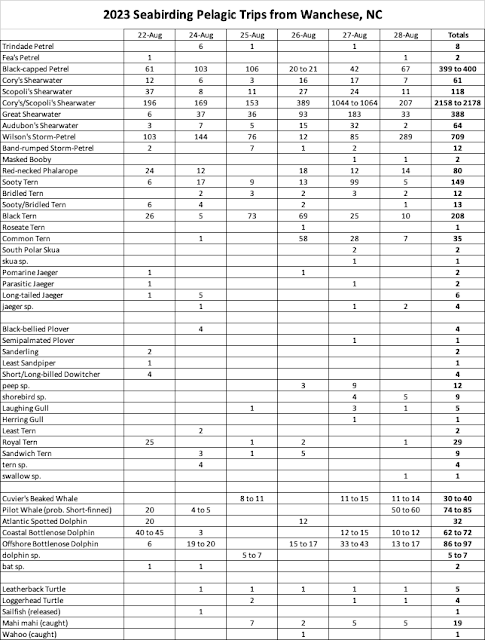
Since it is a lot to type out and still make sense of I put the lists into a spreadsheet which can be viewed below.
~Kate Sutherland
A couple more images of the Fea's Petrel from 22 August by Chris Sloan
-2.jpg)
.jpg)
24 August we had up to six Trindade Petrels, three light morph and three dark morph. Bird #1 was a dark individual that came in well to the slick (top K. Sutherland, bottom C. Sloan):

.jpg)


Black-capped Petrels were definitely up there east of Oregon Inlet with a couple of trips tallying over 100 individuals! It was nice to find flocks sitting around on the water and our Fea's Petrel on the 28th flew in to sit on the water with a nice flock of Black-caps! We saw both light and dark forms in varying stages of molt as would be expected.
Light form individual above, dark ones below (K. Sutherland)


The Masked Booby from our trip on 27 August! What a treat to find this adult bird in with our shearwater flock. It was funny how difficult it was for people to see at first because we were just so overwhelmed with seabirds! (K. Sutherland)


Shearwaters were, as you might imagine, a highlight for this set! We had really incredible views of both Atlantic Cory's and Scopoli's Shearwaters on every trip and here you can see both in one frame, Atlantic Cory's front and Scopoli's back right! (K. Sutherland)

.jpg)


(K. Sutherland)


.jpg)


.jpg)

-4.jpg)

In this image you can see the pale scars that show well on these whales. The males have teeth that erupt from the lower jaw that they use when competing with one another to wound the other. These scar patterns along with dorsal fin shape and other patterning can help us identify individuals. (B. Patteson)
 Females and younger whales do not typically show much scaring so they can be a bit more difficult to get a unique ID on, but some, like the one pictured in the blog text above, have unique wounds on or shapes to their dorsal fins that help! Coloration can also be unique in these animals. This image below looked like a mother / young pair or at least an adult with a younger individual to the left! (K. Sutherland)


This Goosebeak not only has some unique scaring on the dorsal fin but also looks like it had some other interaction that caused a cut on the base of the tail (peduncle). We saw at least one other animal with a similar wound in the groups we encountered on these trips. (K. Sutherland)


And one showing the broad based dorsal fin characteristic of Pilot Whales (K. Sutherland)