Monday, May 20, 2013

Saturday May 18, 2013

Last week, as we checked the forecast and watched the weather patterns leading up to Saturday, we knew it had potential.  Despite our attempts to entice more birders to join us on what promised to be a day of slight seas, still just eight birders, half from the Carolinas, were behind the Stormy Petrel II at 0515 Saturday morning.

The first rays of sunshine were reflected on the calm, rippling surface as we headed offshore.  Winds were still very light from the east and were forecast to shift to the south and pick up before the day ended.  The sky was mostly cloudy and as we headed south southeast it was clear there were some storms offshore!  Just after 0600 a Parasitic Jaeger flew by the boat, pausing ahead to "engage" a tern in an aerial display.  Common Loons were seen swimming and diving on the way out, and one, young Northern Gannet flew by behind us.  0800 found us looking at the Gulf Stream edge ahead, and we slowed down as we crossed the 7 degree temperature break, entering the current - today moving swiftly to the northeast.  A couple of Laughing Gulls were on the change, but no terns, and in short order we had added Cory's, Sooty, and Audubon's Shearwaters to the day's list.

The first Black-capped Petrels were seen just after 0915 and while we were watching them, a dark Trindade Petrel streaked by towards the glare, upwind of the chum.  Even though Brian turned the boat and tried to entice the bird to make a closer pass, it continued on its' way.  A handful of Wilson's Storm-Petrels began to gather in our fish oil slick, and at quarter to ten a Fea's Petrel popped up just off the port side whizzing by close enough for everyone to see, but not lingering!

Energy was high as the novices aboard excitedly studied the Black-capped Petrels - having now seen three species of gadfly petrel - and we continued scanning for something new.  Over the next hour we saw two Leach's Storm-Petrels and soon after 1100 we were showing passengers the first Band-rumped Storm-Petrel of the season!  Most of the activity we found was around 500 fathoms so we focused our energy there.  A couple more Band-rumpeds turned up in the slick, most showing wing molt consistent with Grant's, plus one smaller, non-molting individual was seen, though it eluded our cameras!  Before 1pm, with my gloved hands full of frozen chum, another Fea's Petrel flew right in toward the stern of the boat!  Nate Dias alerted everyone and we all had excellent, close views as the bird darted around in the slick and then flew off!

Two Pomarine Jaegers were seen in the afternoon, one flew by, but the other stayed in the slick harrasing Wilson's Storm-Petrels for over 30 minutes!  At 3 we pulled in the fish oil and picked up speed to head back to Hatteras Inlet, but there was still more to see!  We rounded the trip off with a nice flock of Red-necked Phalaropes inshore, plus many non-avian species that we slowed to check out in the cooler, green water.

We would like to thank everyone who joined us for the excellent day offshore Saturday!  Thanks to Nate Dias and Jeff Lemons for allowing us to use some of their photos, the remainder were taken by Kate Sutherland.

Trindade Petrel (dark)   1
Fea's Petrel   2
Black-capped Petrel   24
Cory's Shearwater   11-12
Sooty Shearwater   3
Audubon's Shearwater   10
Wilson's Storm-Petrel   275-300
Leach's Storm-Petrel   4
Band-rumped Storm-Petrel   4-5
Red-necked Phalarope   29
Pomarine Jaeger   2
Parasitic Jaeger   1

Pilot Whale (prob. Short-finned)   6
Atlantic Spotted Dolphin   5
Bottlenose Dolphin (offshore) 15-20
Risso's Dolphin   4+
Loggerhead Turtle   2
Scalloped Hammerhead   1
Blue Marlin (seen)   1!

Trindade Petrel photos by Nate Dias


Second Fea's Petrel - photos Nate Dias


Black-capped Petrel

Sooty Shearwater - photo Jeff Lemons

Audubon's Shearwater
Leach's Storm-Petrel
Band-rumped Storm-Petrel
Awesome shot of the Parasitic Jaeger & Royal Tern! (Jeff Lemons)
Pomarine Jaeger
Short-finned Pilot Whale
Loggerhead Turtle
 Blue Marlin - photo by Nate Dias
Post updated 1015 May 20 to add two photos by Jeff Lemons!

Wednesday, February 27, 2013

February 24, 2013 "Aukorama"

What we find on winter boat trips off Cape Hatteras can vary greatly from one week to the next depending on the near shore water temperatures.  The warm Gulf Stream current, which brings us such rare and exotic birds during the spring and summer, can really put a damper on the winter birding when it washes some blue water up to Diamond Shoals.  This happened to us week after week last winter, and as a result, we saw few alcids on most of our trips, this just a year after seeing hundreds of Dovekies per trip for weeks.  It was not so bad for the skuas though, as we saw them on each trip, which was our best ever season average.  Prior to Sunday's trip, I must admit I did not have high hopes.  We had been skunked on skuas on both trips the weekend before, and I felt like the cold water would be limited to a thin strip on the north side of Diamond Shoals - good enough for Razorbills, but probably not much else.  Gannets had been scarce and I thought this was not a good sign for Great Skua.  Heavy cloud cover meant there had not been a satellite photo of the area water (showing the temps) for a couple of days, so there was not much to do but hope for the best.  We had settled on running the trip from Hatteras, so I hoped we would not have to run way north to find cold water.

It was slightly foggy when we left the dock around 6:26 AM, but it soon cleared up.  The pipe dredge working on clearing the channel hadn't made much progress, so we had to make about a seven mile detour through Pamlico Sound to get to the ocean.  When we got to Hatteras Inlet, we found Razorbills inside the inlet.  When we made it to the ocean, the water was in the high 40s, so things were looking up.  Not knowing how extensive this band of cold water was, I headed east to Diamond Shoals and crossed to the north.  Numbers of Razorbills increased as we went.  We had seen a hundred or so by the time we got across the shoals, as well as a couple of Manx Shearwaters.  The first hour north of the shoals, we saw over 400 more Razorbills and we were just getting into it.  Between 10:00 and 11:00 I counted 765 Razorbills and that was probably low.  We also saw 15 Manx Shearwaters that hour and we were just three or four miles off the beach.  Heading eastward, the Razorbills continued in great numbers until we got into slightly warmer water.  The water had been about 46 degrees, but when it approached 50, we started to see small flocks of Dovekies buzzing around.  We saw about a hundred in thirty minutes, as well as the first few puffins of the day.  The water was a little choppy, so we could only see the close puffins, which for the most part were not flying.  We kept heading offshore, looking for warmer water and hopefully some Red Phalaropes, and maybe a fulmar.  We found the phalaropes and had good looks at dozens on the water.  We turned around in about 50 fathoms, where the water was in the mid 60s.  There was not a hard change there;  it just got rougher.  A few minutes later a Black-capped Petrel came zipping up the wake and gave us a good, long look.  As we worked into cooler water, we saw more Dovekies, including a few on the water.  One of these diminutive birds was snatched up by a Herring Gull, which soon dropped it.  When it returned to the surface, it was plucked from the water by a Great Black-backed Gull.  Then there was a big melee behind the boat, as more Black-backs fought to get the Dovekie, but in turn lost to a gannet, which choked it down.  Sad to see, bur for some reason, I was glad it was a gannet that prevailed over the gulls.  Just before 2:30 I glanced out the port side window and something caught my eye.  It was the old brown bomber from across the sea.  People had also just seen it from the stern.  We were in about 20 fathoms, south of Diamond Tower, which I suppose are prime waters for a traveling Great Skua.  The bird rushed the gull flock, but soon disappeared.  Many saw it, but a few did not, despite a quick turnaround and some instructions.  It was just not a close encounter, and this is typical of the Bonxie when we see it here.  An hour later, we were about ten miles from the inlet and only seven miles off the beach.  Kate was on the stern and started screaming.  I figured I knew what was going on and I was right.  There was another skua back there raising hell with the gulls.  This one  also kept some distance, but stayed around a bit longer.  From there it was a nice ride back in, with more Razorbills, including a flock of 18 maybe a mile up the sound!

Thanks to everyone who came and to Kate Sutherland and Scott Winton for leading the trip with me.

List of Target / Bonus Birds for Sunday February 24, 2013

Black-capped Petrel  one
Manx Shearwater  22 (probably more)
Red Phalarope  200 or more
Iceland Gull  one adult (Kumlien's)
Great Skua  2
Razorbill  2000 (fairly close count rounded by less than one percent)
Dovekie  232
Atlantic Puffin  15

We also saw plenty of gulls and gannets, including many Lesser Black-backed Gulls and hundreds of Bonaparte's Gulls. There was a Laughing Gull just inside the inlet.  They begin arriving about now.  There were many Red-throated Loons miles off the beach, but just a few Common Loons.  We saw several Loggerhead Turtles, a couple of Hammerhead Sharks, and many Bottlenose Dolphins.  The weather was nice with slight seas and light to moderate northerly winds, but not much sunshine.

Captain Brian Patteson (Photos from February 24, 2013 by Kate Sutherland)

Manx Shearwater
 Manx Shearwater
 second Great Skua!
 Dovekie and victorious Northern Gannet
 Razorbill
 Atlantic Puffin
 Atlantic Puffin
Northern Gannet
 Northern Gannet
 adult Iceland Gull (Kumlien's Gull)
 Lesser Black-backed Gull
 Lesser Black-backed Gull
 Our faithful flock!

Wednesday, February 20, 2013

February 16 & 18, 2013

Due to some other commitments, we had to cut back our schedule of winter seabird trips from Hatteras this year, so it was good to finally get out on the water with a group over President's Day Weekend.  We ran the first trip on Saturday, which was a nice sunny day with light to moderate northerly winds.  There was a mix of participants.  some were birders who were keen to see a Great Skua, and others were students from Duke University who had come with Jeff Pippen to see whatever was out there.  On Saturday, we explored the waters north of Diamond Shoals as we often do.  Although the water  was a bit warmer than what we had hoped for (temps in the low to mid 50s), we soon found large numbers of Razorbills, the most we had seen in years.  Somewhere about three miles offshore between Buxton and Avon we tallied over 400 Razorbills in an hour.  That was pretty strong, considering we saw less than a hundred there last year in four trips!  We headed offshore when we got north of Avon.  It did not take long before we found even warmer water, but fewer birds.  These inshore waters are often inhabited by Great Skuas, but they were MIA on Saturday.  I was hoping to find some sort of temperature break on the shelf that might be suitable for Dovekies or puffins, but the water was pretty well blended.  There were quite a few Red Phalaropes buzzing around in the sixty-some degree water, but none would settle close for a good look.  It seemed as though they were looking around for a water-front (not a waterfront...) too.  A couple of Dovekies flew by as well.  We were fortunate to have a close flyby Atlantic Puffin, which many participants saw well.  When we got back into cooler water near Diamond Shoals, we saw a few more flocks of Razorbills, which were southbound.  The wind picked up as we went along, but we had a fairly easy ride back in the lee of Cape Hatteras.  I did not tally the Razorbills until the trip was over and when I did , I found that it was our highest count ever - almost a thousand auks!

Trip list of Target Species for Saturday February 16, 2013

Manx Shearwater  2
Red Phalarope  141
Razorbill  989 (mostly flying, but plenty of good looks)
Dovekie  2
Atlantic Puffin  1

We also saw Common and Red-throated Loons, Double-crested Cormorants, Brown Pelicans, many Northern Gannets at point blank range, and Bonaparte's, Herring, Lesser Black-backed, and Great Black-backed Gulls.  The birds were hungry and quite responsive to our chumming all day long.

Bottlenose Dolphins, which are often very abundant on our winter trips, were present near shore in smaller than usual numbers.  We also saw a Humpback Whale, which surfaced very close to the boat, and a couple of Loggerhead Turtles were seen farther offshore.

Strong winds and rough seas kept us ashore on Sunday, so we ran the second trip on Monday.  It was still a bit windy when we headed out Monday morning, but we found plenty of birds close to shore in the lee of the Cape.  Thirty-some hours of strong northwesterly wind had changed the water up, and we found a nice color change with 48 degree water on one side just south of Diamond Shoals.  This condition was populated by many Bonaparte's Gulls and quite a few Razorbills.  It was a great opportunity to photograph Razorbills, and they did not seem quite as skittish as they often are.  At the same time we were watching auk after auk, the gulls were going bananas, landing on the back of the boat and eating chum right out of the scoop!  I followed this color change for several miles and in doing so ended up about 14 miles southeast of Hatteras Inlet, which is not somewhere I expect to be on a winter trip.  Most times we are east or even east-northeast of the inlet by late morning.  I hoped we would see a puffin or a Dovekie on the color change inshore, but it did not happen.  We had seen a Dovekie just east of the inlet early on, so I had high hopes.  We did see some Manx Shearwaters along it though.  It seemed like our best bet to find some more life and different birds would probably be a blue water change offshore, so we jogged out to the shelf break to check it out.  We found a nice rip in about 100 fathoms and instantly added Red Phalarope to the day's list.  There were many Bonaparte's Gulls there too.  After a few minutes, we found a puffin and after several minutes of it playing hide and seek, everyone had seen it well.  There were not many Razorbills on that change, but we did find a few more puffins.  There was an adult Little Gull among the Boney's, but it soon disappeared, as the birds were moving quickly to the east.  A Manx Shearwater gave good looks, resting on the water close to the boat before moving on.  Heading back in, we had a nice ride on smoother seas and we saw a number of Razorbills, mostly within a few miles of shore.  It would have been nice to see a skua, but we have missed them before, and likewise fulmars and kittiwakes.  It's not everyday that we see puffins on the Hatteras trips, and the Razorbill show was the best ever, so it was definitely a trip to remember.

Trip List of Target Species for Monday February 18, 2013

Manx Shearwater  4
Red Phalarope  85
Razorbill  "only" 377, but mostly on the water today, few flying
Dovekie  1
Atlantic Puffin  5
Little Gull  1

We also saw the usual loons, cormorants, scoters, pelicans, gulls, and gannets.  One young Brown Pelican followed us offshore for many miles.  There was a flock of six Forster's Terns on the water 17 miles out in the afternoon.  We saw both inshore and offshore Bottlenose Dolphins and five Loggerhead Turtles.  Gulls landed on one of the turtles, which had many barnacles on its' shell.  We had a quick look at an Ocean Sunfish while underway.

I would like to thank everyone who came along.  Kate Sutherland and Bob Fogg led both trips and Jeff Pippen helped on Saturday.  I ran the boat and spotted a few birds too, but got to stay warmer than most.

Captain Brian Patteson

The feeding frenzy shot taken through a scupper! (Brian Patteson)
Manx Shearwater (Bob Fogg)
 A very cooperative Manx Shearwater! (Bob Fogg)
Northern Gannet - at times they outnumbered the gulls around the boat! (Bob Fogg)
Northern Gannet (Bob Fogg)
 Red Phalaropes (Bob Fogg)
 Bonaparte's Gull and Razorbill on the water (Brian Patteson)
Second cycle Lesser Black-backed Gull (sorry for original misid!) feeding on Loggerhead Turtle's barnacles (Brian Patteson)
 Breakfast at the Offshore Cafe...(Brian Patteson)
 Lesser Black-backed Gull - at times they outnumbered the Great Black-backed Gulls! (Bob Fogg)
Razorbills with the beach in the background (Bob Fogg)
 Razorbill (Bob Fogg)
 Razorbill (Brian Patteson)
 Incredible shot of Razorbills in flight! (Bob Fogg)
 Razorbill (Bob Fogg)
 Razorbill (Bob Fogg)
Razorbill (Brian Patteson)
The flyby Atlantic Puffin from Saturday, it was fast! (Bob Fogg)

Sunday, January 27, 2013

January 19, 2013 Photos

Here are some of the images from the January 19, 2013 pelagic trip from Lynnhaven Inlet.  Scroll down to last weekend's post for the trip report by Ned Brinkley.  The Atlantic Puffins, Brian said, were the best he's ever seen them;  we could not resist overdoing it just a little - they were so cooperative!  Thanks to Ned Brinkley, Dave Shoch, and Bob Fogg for sharing their photos.  Thanks again to everyone who joined us!

Northern Fulmar (Dave Shoch)
Manx Shearwater (Bob Fogg)
 Red Phalaropes (Dave Shoch)
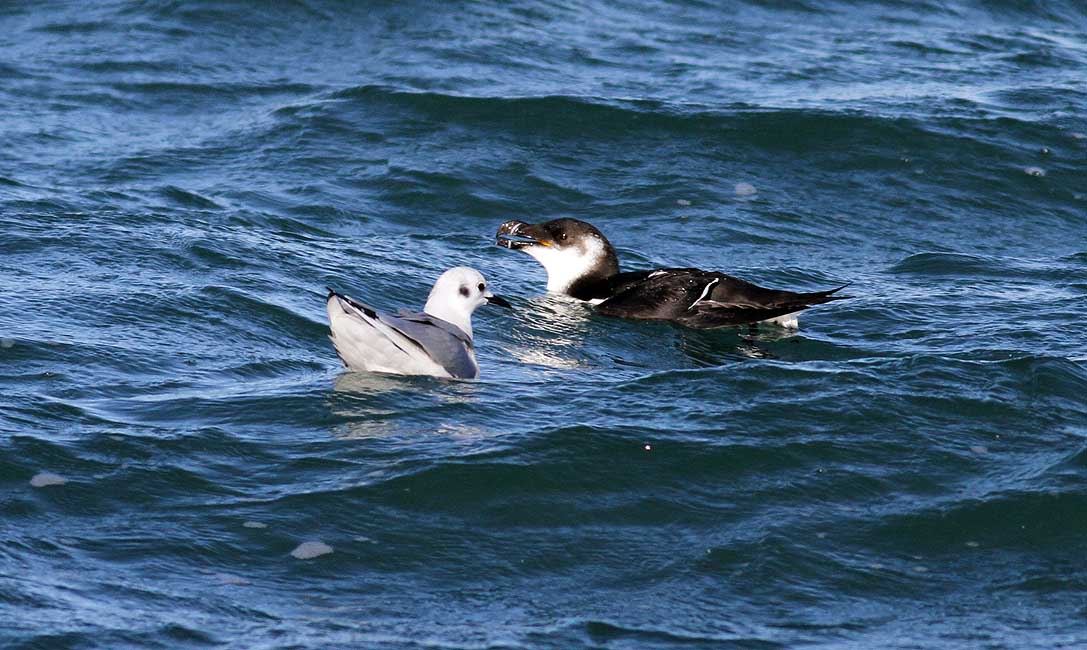
tarrock (first-cycle) Black-legged Kittiwake (Dave Shoch)
 adult Black-legged Kittiwake (Dave Shoch)
 Iceland Gull (Ned Brinkley)
 Iceland Gull (Dave Shoch)
Dovekie (Bob Fogg)
 Dovekie (Dave Shoch)
 Razorbill (Dave Shoch)
 Razorbills (Bob Fogg)
 Razorbills (Bob Fogg)
Atlantic Puffins (Brian Patteson)
 Atlantic Puffin (Brian Patteson)
 Atlantic Puffin (Dave Shoch)
Atlantic Puffin (Ned Brinkley)
 Atlantic Puffin (Kate Sutherland)
 Atlantic Puffin (Bob Fogg)

Sunday, January 20, 2013

January 19, 2013 - by Ned Brinkley

No pelagic trip is perfect, but some come closer than others.  This one was very close!

At 5:00am, a dozen-and-a-half birders congregated dockside at Lynnhaven Inlet, hoping, as birders always do, for a wonderful day offshore.  The waters of the inlet were glassy calm, and Captains Patteson and Sutherland checked us in and fired up the engines for what would be a nearly perfect winter pelagic trip!

As we cleared Cape Henry in the darkness, a few Northern Gannets, Common and Red-throated Loons, and scoters swept by, with only stars and moon to illuminate them.  Many of us napped, but others chatted about what we might see, on Virginia's first winter pelagic in seven years.  As the day began to dawn, the first Razorbills, then Dovekies began to appear about 18 miles off the cape, and eventually we slowed down to enjoy both species at very close range and at leisure.  Bonaparte's Gulls dotted the horizon, and we watched them carefully for Little Gulls.

For those who remember the pelagic adventures of yesteryear, the contrast to the modern experience - with a captain who is not only the boat owner but also the North Atlantic's foremost authority on pelagic birds - is stark.  Back then, we hoped the captain might be coaxed into stopping for a bird before it flushed, never to be seen again!  With Captain Patteson and first-mate Sutherland, we eased up close to the birds, which were always in perfect light, always close enough to photograph well.  It was like going on a photo-safari!  This sort of approach takes many years at sea to master, and it's likely that no one else in the world can get so close to Dovekies that you can hear them calling, as we did with one that morning!  The "presentations" of these birds seem effortless, but they in fact require a subtle understanding of, and respect for, each species' behaviors.  We were spoiled with studies.

As we pushed farther offshore, having enjoyed these more numerous pelagic species, we kept a constant vigil in the bow, everyone calling out their Razorbills and Dovekies for others to enjoy.  I kept track of both species, singing out the new totals each time they went up: "One hundred eleven; and twelve!"  Eventually, with almost twelve hours of continuous watching from the bow (and a few extra birds seen only from the stern), we tallied 458 Razorbills, shattering the old state high count of 140, and at least 47 Dovekies, many of those very well seen.  Ellison Orcutt, James Fox, and Linda Chittum spent a great deal of time on the bow, spotting the majority of these great alcids.  Thanks, guys!  It was a great day for learning how to identify both species at varying distances.

Dave Shoch, one of the boat's leaders from Charlottesville, then fired up all on board with the call of "SKUA!"  Out in the distance, a Great Skua hurtled along, identifiable mostly by the shape, flight, and those big white patches in the wing, and Captain Patteson gave chase!  We got a bit closer, and a few got identifying glimpses, but the bird then left us in the dust, as so many skuas do.  We will need a rematch.

Just as the skua chase was getting underway, a flock of about 25 Red Phalaropes careened down the starboard side, leaving us wondering whether to look forward or aft!  We would eventually see another 68 of these pretty dove-gray-and-white seabirds, many of them resting quietly on the calm sea.

"KITTIWAKE!" was suddenly the word from the stern, and we looked back to see a tarrock (first-cycle) Black-legged Kittiwake wheeling in the wake with a Ring-billed, 16 Great Black-backed, and a dozen Bonaparte's Gulls.  That kittiwake number grew to ten, then 14 over the next few hours, with both adults and youngsters moving in and out of the flock that followed the boat, accepting handouts of fish-and-fat chum from Sutherland.

What more could we hope to see?  "PUFFINS!" came the call from Dave Shoch, and sure enough there were two adult Atlantic Puffins sitting quietly, just off the bow, both of them seemingly very pleased to be the center of attention for the next 15 minutes or so.  Photographers filled their frames (and their memory cards) - and even had time to enjoy the birds through binoculars!

By lunch time, the list of possible new winter pelagic species had gotten rather small, with only a tubenose, or perhaps a jaeger, still likely for the day's list.  And just as we were getting into position on a small flock of phalaropes, "FULMAR!" was announced over the boat's speakers, with the footnote: "Phalaropes in the bow, fulmar in the stern, take your pick."  The first fulmar, then another, did a lap or two around the boat, giving everyone a good look.  Finally, a big white gull at first thought to be a Glaucous (in the distance), did the same star turn around the boat, showing itself to be an Iceland Gull instead, a rather husky one, to be sure.

By mid-afternoon, some 60 miles offshore, it was time to turn around and head back to port.  We were experts in identification of fulmar, the regular alcids, kittiwakes of both age classes, and phalaropes, so we set our sights on the next possibilities: Manx Shearwater, and the murres, all the while watching the gull flock off the stern for a new species of gull, a jaeger, or perhaps ... that elusive skua.    

Just as the Chesapeake Light Tower came into clear view, a Manx Shearwater came cutting toward us from the starboard, crossing close behind the wake, for a great view, narrated clearly from the bridge so that everyone could see it.  For good measure, another one crossed the bow just 15 minutes later, as we were about 15 miles offshore.  Our tenth and last puffin of the day was seen about 31 miles offshore; our last Dovekie about 19 miles; and our last Razorbill about 10 miles from Cape Henry.  All the while we strained our eyes for murres, and discussed their identification and behavior, but we will have to find them on the next outing!

Perhaps the greatest avian spectacle of the day awaited at the approaches to the shipping channel east of Fort Story.  Many thousands of adult gannets, all painted fulvous by the late afternoon light, flew by us, almost close enough to touch, as if following a very large school of fish.  It was like being on the Serengeti during a movement of Wildebeest!  At least three Humpback Whales appeared around us, showing us breath, back, and flukes, as they gorged themselves on whatever baitfish were around.  A few Lesser Black-backed Gulls at last turned up, helping us with our gull list, but jaegers (sometimes here) were not to be seen, as the light left the western sky.

As we pulled up to the dock at Lynnhaven Inlet, we were greeted with a volley of applause from the local Clapper Rails, as if to mark our good fortune offshore.  Many then enjoyed a superb seafood meal dockside, savoring the day's birds along with the coastal cuisine.  And many were heard to murmur about murres (and more skuas!), hoping that the next Virginia pelagic will be soon!

(Ned Brinkley, a leader on our trips since they began (and a friend of Brian's long before that), resides in Cape Charles, Virginia.  We thank him for helping us lead this trip along with Dave Shoch (of Charlottesville) and Bob Fogg (of Cape May, NJ).  Kate thanks him also for helping out by jazzing up our blog with this trip report!  Look for some photos here later this week...)