Monday, June 5, 2017

Sunday June 4, 2017 - by Brian Patteson

I was not quite sure of what to expect today, as I knew the Gulf Stream had taken a queer turn and we would be looking at different water than what we had been working in the day before. Cloud cover prevented us from getting an up to date satellite image of the offshore waters, so we just had to make a SWAG and head to where we thought the best conditions would be. I wanted to check out the cooler blended water just south of the hard current, and I hoped it would be where we had seen some life the day before in the hot water. We landed in the cooler water about 30 miles south of the inlet around 0800, and by keeping in touch with the charter fleet we were able to figure out where the hot water change was to the north of us. The cooler water was actually about 79 to 80 degrees and the hot stuff got up to 84, which is not what you expect in early June, but the seas have been calm, so the surface water has been holding the heat.

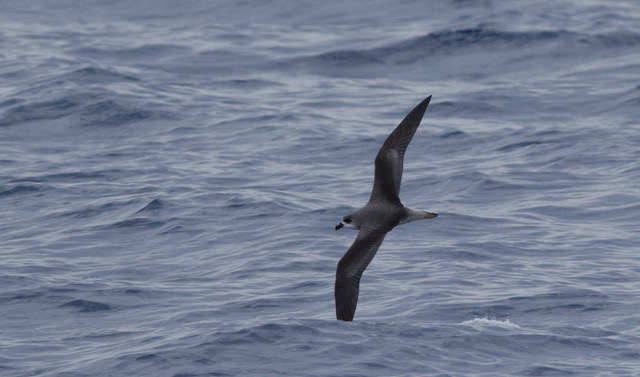
There were a few shearwaters and some Short-finned Pilot Whales in this cooler water, but not too many Black-capped Petrels, so I headed north to see if the petrels were closer to the hot fast water. Along the way, we started to see a few more birds so we slowed down to chum. Within minutes, a Trindade Petrel came in to sniff out the slick. It stayed in view for a while but never came super close to the boat. Nevertheless, we got a few photos and it was nice to compare it to Back-capped Petrels and Cory’s Shearwaters. Photo by Steve Howell  
This was our first Trindade Petrel of the year, and I felt lucky to get it as there were so few birds around, but sometimes they appear on slow days. We had both Atlantic Cory’s and Scopoli’s around, but unlike yesterday, no Great Shearwaters. Scopoli's photo by Peter Flood
 

We kept pushing northward closer to the hot water and went through a vast area of scattered Sargassum. There we saw several individual Audubon’s Shearwaters and a couple of pairs sitting together, but no Bridled Terns. The terns are easier to find when the Sargassum is lined up on a current edge and there is enough flotsam for perches. There were a few Band-rumped and Wilson’s Storm-Petrels around, but overall the storm-petrel numbers were quite low. A couple of weeks of offshore wind is not good for finding storm-petrels here, but we did eventually find a Leach’s Storm-Petrel, so we got all three of the expected species for June.

Around midday we were in the hot fast water and I planned to take it up the northeast, but the current was running inshore instead of up the break. It was also devoid of life, so I decided to jog back south where we had seen a few birds and work inshore from there. We found a few birds back in the blended water, but no new species for the day. Our best find for the afternoon was a couple of Cuvier’s Beaked Whales. Photo by Steve Howell   
They were distant and sounded before we could get a good look, but the water was fairly shallow for them (around 250 fathoms) so I decided to hang out for a while in the area. They are capable of some long deep dives, but they were up in about 20 minutes. We got a much better look that time, but they dove again before we got really close. The ride back to shore was easy and uneventful. We found plenty of water in the shortcut channel and got back to the dock less than 10 minutes after we left the ocean behind.


Today was our ninth consecutive trip, and I would like to thank our crew of leaders for their unceasing efforts. Today we had Kate Sutherland, Steve Howell, Peter Flood, and our greenhorn, Sage Church. Steve and Pete have headed home, but Kate, Sage and I will be back out on Friday and Saturday and there is plenty of space for others to join us. It looks like we get some northeasterly winds for a couple of day before we start so it should be great birding by the end of the week.

Trip List June 4, 2017
Trindade Petrel  1
Black-capped Petrel  16
Cory's Shearwater  31
Audubon's Shearwater  24
Wilson's Storm-Petrel  22
Leach's Storm-Petrel  1
Band-rumped Storm-Petrel  8
Laughing Gull  1
Common Tern  2
jaeger sp.  1

Cuvier's Beaked Whale  2
Short-finned Pilot Whale  12-14

Sunrise by Steve Howell
Another record shot of the Trindade Petrel by Peter Flood
Dorsal view of a Scopoli's Shearwater by Peter Flood
Ventral view of one by Steve Howell
We were able to approach some shearwaters on the water as well, these both looked like they were perhaps the nominate type of Cory's Shearwater (Scopoli's) by Peter Flood
Audubon's Shearwaters were quite cooperative today!
And finally one of the Band-rumped Storm-Petrels from today, photos show it is growing p8, so still finishing molt like the Grant's type - by Steve Howell

Saturday, June 3, 2017

Saturday June 3, 2017 - by Steve Howell

Everyone enjoys seeing boobies, and today was no exception. Add to this some superb marine mammal sightings and good opportunities to watch the different storm-petrel species and it was “just another amazing day offshore” in the Gulf Stream. Conditions were mostly calm with low rolling seas and some impressive, ‘boiling’ white cloud formations, although a southwest breeze picked up in early afternoon to freshen our ride back to shore. The calm seas made for some nice flyingfish on the ride out, here an immature type known as “Purple Bandwing.” Photo Steve Howell 

Shortly after slowing down a pod of pilot whales showed well, logging at the surface in the gentle seas. Photo Steve Howell  

Black-capped Petrels appeared steadily, but with the calm conditions many were sitting on the water, several of them feeding. As on previous days the black-faced type predominated and only a few white-faced birds were seen, here sitting together—the difference is pretty obvious!  Photo Steve Howell

More Black-capped Petrels and a few Audubon’s and Cory’s Shearwaters marked our passage towards to shelf break, before a radio call from one of the fishing boat captains alerted us to a pod of Sperm Whales. We soon found the animals, which were in unusually shallow water and quite tightly grouped—in only 800 feet of water and only 27 miles from the inlet. It looked like a group of mostly young animals and Brian maneuvered the boat to give some excellent views.  Photo Steve Howell 

Continuing into the deep blue the storm-petrels following the boat offered some challenging opportunities to pick out Band-rumped and Leach’s from the Wilson’s. For a change of pace, a near-adult Pomarine Jaeger made some nice passes overhead and showed how the ‘spoon-tipped’ tail projections are twisted to 90 degrees and thus can look ‘atypically’ pointed from directly below! Compare these two images:  Photos Steve Howell. 

The heat was settling in and things started to quiet down, but then one of our group of visiting Irish seabird enthusiasts shouted “Kogia!” and sure enough three of these rarely seen animals were logging at the surface, although as always they quickly ‘sank’ from view and only a few lucky souls got to see them—thanks Niall! The genus Kogia comprises the Pygmy and Dwarf Sperm Whales, two very similar species of small, poorly known cetaceans. One animal showed a classic Dwarf dorsal fin; the other two were less clear-cut, but presumably also Dwarf Sperm Whales. Photo Steve Howell 

“Larger storm-petrels” (i.e., Band-rumped or Leach’s as opposed to the smaller Wilson’s) continued to appear in the chum slick, and while looking back there several people called out “booby!” and sure enough a nice near-adult Brown Booby flew over the slick and up the starboard side of the boat, although sadly it kept on going rather than electing to come in for a close view.  Photo Steve Howell. 

Storm-petrels continued to show in the slick among the Wilson’s, and by the end everyone had seen Leach’s and Band-rumped well—or at least as well as they tend to be seen. Adding to the challenge, a fresh-plumaged Band-rump showed nicely, but not quite close enough to determine whether it was an adult of the summer-breeding Madeiran type (and thus not in wing molt) or a fresh-plumaged juvenile Grant’s type (the winter-breeding population, and the commoner one we see here). Photos Steve Howell. 

An obliging Great Shearwater also joined the feeding birds behind the boat and gave great views, at times in direct comparison with Black-capped Petrels. Photo Peter Flood  

All in all, a really nice day out on the ocean. There’s still room on tomorrow’s trip if anyone feels the desire to get out there (again)...


Thank you to everyone who joined us today!  David Bradford did an excellent job organizing a group that joined us for two trips, plus we had a very keen group from Ireland with us yesterday & today who spotted birds & cetaceans - thanks Niall & Aidan!  A big thank you also to our leaders, Steve Howell, Peter Flood, and Sage Church for all they did to help us out today - we meet at 0515 if anyone wants to join us! (KS)

Trip list June 3, 2017
Black-capped Petrel  49-58
Cory's Shearwater  19
Great Shearwater  4
Audubon's Shearwater  15
Wilson's Storm-Petrel  50-55
Leach's Storm-Petrel  3
Band-rumped Storm-Petrel  11-15
Oceanodroma sp  1
Brown Booby  1
Pomarine Jaeger  1
jaeger sp.  2

Dwarf Sperm Whale  3
Sperm Whale  8-10
Pilot Whale (prob Short-finned)  20-25
Bottlenose Dolphin  2

Black-capped Petrel images - white-faced individuals top by Peter Flood, bottom by Steve Howell
Obliging Great Shearwater behind the boat by Peter Flood
One of the Leach's Storm-Petrels we encountered today by Steve Howell
Another awesome photo of the pod of Sperm Whales by Peter Flood
And finally, some closer images of the Pilot Whales, what a treat!  by Peter Flood

Friday, June 2, 2017

Friday June 2, 2017 - by Peter Flood

Part of the reason one day can be different from the next in the Gulf Stream is that streams do indeed flow.  Well offshore there were instances today when the water was moving at 4 knots.  Weed lines, tidal fronts, differing water masses and color changes can be transported from one area to the next somewhat rapidly in the northerly flowing Gulf Stream.  

Today we once again departed Hatteras Landing under quite pleasant conditions with light westerly winds and mostly overcast conditions. (sunrise by Kate Sutherland)  

In and around the shelf break we encountered a few Cory's Shearwaters and several Audubon's Shearwaters sailing around a Sargassum Line.  Not nearly as many as we had seen earlier in the week.  

A 1st summer Long-tailed Jaeger briefly zipped in towards the Stormy Petrel II for a look at our enthusiastic participants before heading off to the southwest.   Shorty thereafter we began to see our first Black-capped Petrels arcing up on the horizon. (photo by Peter Flood) 

At this point things were quite birdy with shearwaters, petrels and increasing numbers of storm-petrels attending Kate's chum banquet off the stern.  Our second Pterodroma of the day in the form of a Fea's Petrels tacked in towards the boat from the bow and made a nice close pass down the port side to inspect  our chum slick.  The Fea's stayed in view for a couple of minutes showing well and providing long leisurely looks much to the delight of all on board. (photo by Steve Howell) 

A small pod of Pilot Whales briefly flirted with the Stormy Petrel II followed up by an adult Arctic Tern that spent a couple of minutes off the stern.

A Long-tailed Jaeger returned (perhaps the same bird seen earlier) and was eager to harass three Laughing Gulls which had become far too comfortable feeding off the stern for the past couple of hours.  The jaeger stayed with us for several minutes and was seen well, and photographed well.  (photo by Peter Flood) 

The northerly component of the offshore winds today blowing against the current seemed to provide better conditions for storm-petrels as we had a nice solid following of Wilson's Storm-Petrels with an occasional Band-rumped and Leach's Storm-Petrels zipping through our chum slick. (photo of fresh Band-rumped by Peter Flood)


By late morning the winds a slackened considerably providing near glassy conditions over a gentle swell.  A few additional Pilot Whales were seen along with some Bottlenose Dolphins  - a couple of which engaged in some bow-riding in the crystal blue Gulf Stream water.  Looking forward to another and no doubt different day tomorrow!  -Peter Flood

Thank you to everyone who joined us today!  Our leaders also did an amazing job: Ned Brinkley, Steve Howell, Peter Flood, Chloe Walker, and Sage Church.  Peter did an excellent write up & he and Steve once again were amazing photographers!  -Kate

Trip List June 2, 2017
Fea's Petrel  1
Black-capped Petrel  58
Cory's Shearwater  26
Audubon's Shearwater  24
Wilson's Storm-Petrel  105-125
Leach's Storm-Petrel  4-5
Band-rumped Storm-Petrel  9-12
Oceanodroma sp  3
Bridled Tern  1
Arctic Tern  1
Long-tailed Jaeger  1-2
Laughing Gull  4
Pilot Whale (Prob Short-finned)  22-27
Bottlenose Dolphin  25+
hammerhead sp  1

Fea's Petrel!!  Photo by Peter Flood (top) and one courtesy of Scott Spangenberg (bottom)
We found some Black-cappeds on the water today, Steve captured this shot of the two types side by side, which could some day prove to be separate species.  (white-faced L, dark R)
Wilson's Storm-Petrels by Steve Howell - molting adult with yellow webbing on feet (top) and fresh juv (bottom)
The Long-tailed Jaeger (both photos same bird) as an example of how light in photos can change what you see!  Top looks like 2-3 white primary shafts (typical for LTJA) and bottom the light is reflecting to show what looks to be 5-6!
Some photos of the Pilot Whales (Peter Flood)
 Pilot Whale & Wilson's Storm-Petrel (Steve Howell)

Thursday, June 1, 2017

Thursday June 1, 2017 - by Steve Howell

As a mate on one of the fishing boats here once said: “Today is typical of today” and that’s the truth of oceanic birding.  Every day this week has been different, and today was the same (if that makes sense). We headed out early in somewhat choppy seas under mostly cloudy skies that prevailed through the day. Minutes after Kate mused “well it’s June, time for the Pseudorcas...” Steve said “There’s a dolphin...” as a big fin cut the water off the bow and Brian and Kate in stereo yelled “Pseudorcas!!” We spent the next ten minutes or so circling as a loose pod of False Killer Whales (really a big dolphin, in the genus Psuedorca) milled around us, bow-riding and even somersaulting in spectacular breaches—what a way to start the day! Photo by Kate Sutherland


Shortly before reaching the shelf break we crossed a front (an area where two water masses meet, analogous to atmospheric fronts you see on the weather charts) that produced nice close flocks of feeding Cory’s and Audubon’s Shearwaters over boiling fish (likely skipjacks). Shortly afterwards a Bridled Tern was spotted resting on a “Baby Float” life vest and Brian pulled the boat up right alongside for point-blank views. Photo Steve Howell
Passing into deep water a Band-rumped Storm-Petrel joined the Wilson’s following in the fish-oil “chumway” that trailed the Stormy Petrel 2 and the first Black-capped Petrels appeared.

One of our Black-capped Petrels, most of which this spring have been on the black-faced type, as here. Photo Steve Howell

The seas mellowed out and clouds made for pleasant viewing as we steamed slowly on in search of birds. Over the course of the day everyone enjoyed good views of Black-caps and Band-rumps (which today were all of the winter-breeding Grant’s type) as we headed out into the second biggest desert on the planet—the Tropical Atlantic (the Tropical Pacific being the biggest—it has been said that the Pacific is vast, the Atlantic only half-vast).

A molting (and thus winter-breeding) Band-rump: note the faded outer primaries yet to be molted, and how a feeding bird rests on the water with wings raised, not pattering with long legs like the Wilson’s. Photo Steve Howell


Birds were sparse out in the deep blue desert, but in late morning a 1st-summer Arctic Tern put on a great show, circling the boat several times. Note how this age has a relatively broad black trailing edge to the primaries, a dark leading edge to the upperwing, and can show translucent inner primaries—all “traditional field marks” of Common Tern! In such cases, structure and uniform-generation primaries are key ID features. Photo Steve Howell


As energy waned in the slow rolling seas and some people were dozing or munching lunch, Ned in the pulpit picked up a distant white speck on the sea—our first tropicbird of the season, a 1st-year Red-billed with an orange bill (transitioning from the dull yellowish of a juvenile to the red of an adult). We pulled up for great looks at this scarce, almost annual visitor, never a predictable bird and always fun to see.
Photo by participant Skip Russell

As we worked our way back inshore a Common Tern joined us, followed by a puzzling 1st-summer jaeger that harassed the tern briefly. Consensus (upon review of photos) settled on Long-tailed. Basically there are two kinds of birders: those who find first-summer jaegers challenging and those who pretend they don’t.  Photo Steve Howell


All too soon it was time to speed up and begin our commute back to the dock...

Thank you to everyone who joined us today!  Also a big thank you to our leaders: Ned Brinkley, Steve Howell, Peter Flood, Chloe Walker, & Sage Church - they did an awesome job spotting birds and getting everyone on them.  Thanks to Steve for the post and photos, Skip Russell for his Red-billed Tropicbird photo, and Peter Flood for the photos below!

Trip List June 1, 2017
Black-capped Petrel  50-55
Cory's Shearwater  20-21
Audubon's Shearwater 87-90
Wilson's Storm-Petrel  50-55
Band-rumped Storm-Petrel  3-4
Oceanodroma sp.  1
Red-billed Tropicbird  1
Laughing Gull  1
Bridled Tern  5-6
Common Tern  2
Arctic Tern  1
Royal Tern  2
Long-tailed Jaeger  1

False Killer Whale  10-12
Bottlenose Dolphin  about 50

Blue Marlin  1
Sailfish  2
Hammerhead sp.  1

A couple more photos of the Pseudorcas or False Killer Whales by Peter Flood - Wow, what an awesome capture of the head!
 Dorsal fin shot...
Another shot of the Band-rumped Storm-Petrel (molting, winter breeder - Grant's type) by Peter Flood
And yes, another photo of the Red-billed Tropicbird by Steve Howell