Thursday, August 19, 2021

August 13 & 14, 2021 - Scrappy Summer Days Pay Off! - Kate Sutherland

The winds were our typical summer direction this past weekend, southerly / southwesterly, skies were sunny and the Gulf Stream water was quite warm!  At times these conditions can be a bit difficult, especially if the winds fall out and we're just searching for birds sitting around on the water.  Luckily we had a bit of breeze at some point on each trip and we were able to find some Black-capped Petrels (photo by Peter Flood)!
Those we saw on Friday were mostly distant and in flight while we were lucky enough to find some flocks on the water Saturday.  At one point we had as many as a dozen!  While they didn't come in to the chum (they must have been feeding well on squid and other prey items), we did get to see them take off and fly quite close to the boat more than once.  For those who were able to join us for both trips they certainly saw our signature species well!  Another deep water species that was more cooperative than usual, and responsive to the chum was Band-rumped Storm-Petrel.  We had around 40 individuals on Friday's trip which is certainly more than we typically find on a couple of trips.  Our first sightings were around 0930 that morning and we set out a chum block to see if we could attract some close to the boat...that was a success and our luck just continued from there.  One Band-rumped who was feeding on what looked like a squid sat very nicely for us as we approached (photo below by Kate Sutherland), and over the course of the weekend we passed a number of squid on the surface.  Which could help to explain the lack of interest in our chum! 

Friday's trip found all of the shearwater species we expect to see in the summer, Cory's, Scopoli's, Great, and Audubon's, some of these were in a nice little feeding flock over some skip jack tuna mid-morning so we has some nice views and comparisons!  Finding some beehives in the summer can be super productive, so we were lucky to see most of our shearwaters in these natural feeding groups.  As the tuna feed on baitfish they push it to the surface kicking the shearwaters into action, taking off and staying with the feeding school until they move deeper under water...then repeating the whole sequence again and again, tracking the feeding fish.  We even got to see one of these feeding groups form near our slick on one of the trips!
Since we didn't see any tropical terns over the feeding groups on Friday we were afraid they still hadn't shown up yet...but on Saturday we found them!  There was a nicer sign of Sargassum on Saturday's trip and first thing in the morning we found some terns working over a line of the floating, brown algae.  First to come into view were a couple of Black Terns, but then a Bridled Tern flew in!  And a couple more followed that one including our first juvenile Bridled Tern of the year!  As the adult and juvenile worked their way down the line we saw a few more tropical terns in the distance that turned out to be some Sooty Terns.  Not a bad way to start the day!  As we worked this nice condition an immature Long-tailed Jaeger came to join the others zipping by us in pursuit of an Audubon's Shearwater (photo by Ed Corey). 
 Before 0900 we had already added three species to the trip set!  Red-necked Phalaropes were another bonus on Saturday because while we had seen a couple on Friday's trip they were not nearly as cooperative as they were the following day.  
Saturday we also had time to dip some Sargassum, there was a lot more life in it than we've been seeing so far this summer and we were excited to see what we might turn up.  A few of our participants were interested in seeing if we could find a Sargassum Fish!  While one wasn't in the bit of floating algae we dip netted from the water, participant Ashwin Srinivasan photographed some of the patches near the boat and sent me this photo the following day!! (check out the bottom right if you don't see it right away!)
 Otherwise we found Sargassum Swimming Crabs, a gorgeous Sargassum Pipefish, Brown Grass Shrimp and a number of Planehead Filefish.  Just after returning the Sargassum and its inhabitants to the sea, leader Ed Corey spotted a large Leatherback Turtle near the boat!  A spectacular end to the trips.  And while birding was a bit scrappy out there with some lulls, 11 species is not bad at all for a couple of summer trips.
Thanks so much to everyone who joined us out there and a big thank you to our leaders, Peter Flood, Ed Corey, and Andrew Rapp.  They worked hard to make sure we didn't miss anything and also contributed photos for the blog!  Our next trips this weekend will have to contend with Tropical Storm Henri, hopefully it will bring us something exciting and unexpected, you just never know!

Species List for August 13 / 14
Black-capped Petrel - 13 / 54 to 64
Cory's Shearwater - 6 / 6
Scopoli's Shearwater - 10 / 3
Cory's / Scopoli's - 125 / 18
Great Shearwater - 18 / 3 to 4
Audubon's Shearwater - 15 / 11 
Wilson's Storm-Petrel - 55 / 94 to 96
Band-rumped Storm-Petrel - 40 to 43 / 11 to 12 
Red-necked Phalarope - 2 / 27 to 28
Sooty Tern - 0 / 5
Bridled Tern - 0 / 4 
Black Tern - 0 / 4
Royal Tern - 0 / 1
tern sp - 1 / 3
Long-tailed Jaeger - 0 / 1
Barn Swallow - 0 / 1
Semipalmated Sandpiper - 1 / 0
peep sp - 1 / 0
Bottlenose Dolphin (offshore population) - 0 / 11 to 15
Leatherback Turtle - 0 / 1
Wahoo - caught 2 / caught 1
Wandering Glider - 0 / 1

Cory's Shearwater (Kate Sutherland) showing the dark under primaries with a Scopoli's pictured below (Peter Flood)

Great Shearwaters were not super cooperative, but the Audubon's were!  Not surprising with the calm conditions and Sargassum we found out there on Saturday.  (Kate Sutherland)


On Friday the long-legged Wilson's Storm-Petrels were pretty close to Band-rumpeds in number!  Not something that happens often (Kate Sutherland)
Band-rumped Storm-Petrels were unbelievably cooperative on Friday's trip! (Ed Corey)
Here is a Band-rumped Storm-Petrel front center with some Wilson's Storm-Petrels.  It was really cool to get some of these mixed flocks sitting on the water! (Peter Flood)

We had a number of Red-necked Phalaropes on the water later in the day on Saturday (Kate Sutherland top, in flight by Ed Corey bottom)

One of the offshore Bottlenose Dolphins we saw on Saturday (Peter Flood)

The impressive Leatherback Turtle we also saw on Saturday! (Peter Flood)
I was excited to see this flying fish with dark "wings" and Peter got a photo of it!  
And a few images from our Sargassum dip!  Top a Sargassum Pipefish (Syngnathus pelagicus) and bottom a Sargassum Swimming Crab (Portunus sayi) (both by Kate Sutherland)

Wednesday, August 11, 2021

August 6 & 7, 2021 - Kate Sutherland

After dealing with weather issues last weekend, we were glad to see that it looked like we would have a nice window to get offshore for our trips on the 6th and 7th.  Winds were light from the east/southeast on Friday and Saturday they were more southerly, with some thunderstorms in the forecast, but we were hopeful we could get out there and work around them, maybe even have some birds riding the edges of the squalls.  Friday we encountered all of our usual, Gulf Stream species, and while birds came in to investigate the chum they didn't really come all that close.  Saturday was the opposite and even our rarities - Brown Booby and Trindade Petrel - came in super close for excellent views!  Those participants who were able to join us for both departures saw 12 pelagic species plus some cooperative offshore Bottlenose Dolphins.  
Gadfly petrels were represented by almost 100 Black-capped Petrels over two days and one fearless, dark morph Trindade Petrel (Ed Corey). 
While the Black-cappeds kept some distance on Friday, Saturday they came in well to the chum and even dropped down to feed in the slick behind us.  We photographed at least two or three birds that recently fledged - always nice to get to see those sharp looking immature Black-cappeds! (Kate Sutherland) 

The Trindade Petrel popped into the slick right behind us a little before 1130 on Saturday, flew off, then circled back putting us in good light and coming in high to investigate.  It was a spectacular view for all aboard!
Shearwaters were cooperative as well with a nice, feeding flock of Cory's, Scopoli's, and Greats on Saturday morning.  It was a bit easier to get nice views of the two different Calonectris shearwaters when they were flying around us closely feeding, since they can sometimes be hit or miss in the slick.  We had a number of Atlantic Cory's in that group, but even more Scopoli's, plus a few individuals photographed that were truly in between.  As many of you know if you have been offshore with us, I am pretty conservative when it comes to slapping an identification on something we are still figuring out and a number of the Cory's / Scopoli's can still have us scratching our heads even when seen well!  Overlap in size and variation for each species can make it difficult to pin down every bird, and those that pass by in the distance, unless seen well and photographed, make it on the list as "Cory's types."  Currently the only feature that is considered diagnostic for separating these two species is the amount of white visible in the underside of the outermost primary, p10.  We differentiate them as Scopoli's having a white tongue of 30% or more and Cory's having little to no white.  Some fall in between and if there are other supporting features, like a slender / thick bill or small / large head, we could identify them as one or the other.  Regardless of how challenging these can be to identify, what is really exciting is that we see a lot of Scopoli's Shearwaters here offshore from Hatteras in the summer!  (Ed Corey) 
Great Shearwaters were cooperative both days coming in well to the boat, but Audubon's were a bit easier to find on Friday's trip and we are seeing both fresh, young birds that have recently fledged in addition to browner, more worn adults.
Wilson's Storm-Petrels were around in good numbers both days and came in well to the fish oil and chum.  It was an incredible opportunity to photograph them close to the boat and it's always exciting to see the yellow webs between the toes and to see them diving for small pieces of fish! (Kate Sutherland) 
We just had one Leach's over the two day set on Saturday, and it didn't show very well.  Band-rumped Storm-Petrels, however,  were super cooperative especially on Saturday!  Most of the individuals that were photographed looked to be growing p10 putting them into the group of winter breeding Band-rumpeds, presumably.
Saturday morning, after working the feeding flock of shearwaters, we decided to toss out a homemade chum block and see what we could entice to visit.  Black-cappeds, shearwaters, and storm-petrels, both Wilson's and Band-rumpeds, were all very cooperative!  A little after 1000 an adult Brown Booby decided to check us out, it must have seen the slick from a distance because it appeared right over the bow, looking down into the water, and flew off.  Obviously we didn't have anything alive to convince it to hang out for a bit and it moved on.  Not before everyone aboard had an awesome view of this sleek sulid! (Kate Sutherland) 
Tropical terns are still a week or two out I guess because if there were any around we might have found some over the shearwater flock on Saturday.  We did see one Bridled Tern in the distance on Saturday afternoon, so hopefully they will begin to show this weekend!  Summer is on the way!
Thanks to everyone who joined us out there and a big thank you to our leaders, Ed Corey, Jeff Lemons, and Andrew Rapp, for making sure that everyone saw the birds and had a great time!  Thanks to Ed for sharing some of his photos for the blog post.  While most of our summer departures are full, we do have space on our fall trips - you just never know what you might find out there! - Kate

Species List for August 6 / 7
Trindade Petrel - 0 / 1
Black-capped Petrel - 28 to 33 / 60
Cory's Shearwater - 6 / 13
Scopoli's Shearwater - 18 / 16
Cory's / Scopoli's Shearwater - 35 / 104
Great Shearwater - 18 / 36
Audubon's Shearwater - 23 / 6
Wilson's Storm-Petrel - 150 to 170 / 130 to 145
Leach's Storm-Petrel - 0 / 1
Band-rumped Storm-Petrel - 4 to 6 / 11 to 15
Leach's / Band-rumped - 0 / 1
Brown Booby - 0 / 1 adult
Red-necked Phalarope - 3 / 0
Bridled Tern - 0 / 1
Common Tern - 1 / 0
Tern species - 3 / 0
Bottlenose Dolphin (offshore) - 15 to 18 / 0
Wandering Glider - 1 / 0

Another image of the Trindade Petrel (Kate Sutherland)
And a dorsal view of the Brown Booby (Ed Corey)
Black-capped Petrels made some nice passes!  Here is the dorsal of one of the fresh individuals (Ed Corey)
Black-capped Petrel ventral with pretty dark margins in the underwing coverts (Kate Sutherland)
Black-capped Petrel dorsal, this individual has a fairly pale face and nape (Kate Sutherland)
Atlantic Cory's Shearwater showing little white in the under primaries, specifically p10.  (Ed Corey)
Scopoli's Shearwater showing that diagnostic white in p10 (Kate Sutherland)
And one showing the more delicate bill (Ed Corey)
Here is one of those birds that is likely a Cory's Shearwater, but had a bit of white in p10 (Kate Sutherland)
And one that I left as a Cory's type that had some white in p10 but not 30% - this one is likely a Scopoli's (Kate Sutherland)
Great Shearwaters have a black bill, blackish cap, and a dark belly patch with mottled looking underwings when compared to Cory's type shearwaters above (Kate Sutherland)
Audubon's Shearwater - these small shearwaters are black above and white below (Ed Corey)
A few more images of Wilson's Storm-Petrels.
Their long legs usually are visible beyond the tail (both by Kate Sutherland)
They were feeding close to the boat on Saturday!
Band-rumped Storm-Petrels have much shorter legs than Wilson's (Ed Corey)
And their wings are much longer than those of Wilson's, compare to photos above! (Kate Sutherland)
Red-necked Phalaropes were fairly cooperative on Friday!  Here you can see the streaked back and fine bill characteristic of this species (Kate Sutherland)
And finally, a nice image of the Common Tern that visited us offshore of the shelf break on Friday! (Kate Sutherland)

Tuesday, August 3, 2021

Saturday July 31, 2021 - White-faced Stormie!! Kate Sutherland

 Our first trips of the summer were scheduled for July 30 and 31 and while the weather was perfect leading up to the weekend, the wind breezed up on Friday causing us to cancel the departure on the 30th.  We had a group from Buffalo, NY organized by our friend Alec Humann and we wanted to get them offshore for at least two days...so we planned to go on the 31st and the 1st.  Again, the weather was just not cooperative for two days offshore!  So we made it on one, Saturday, and it poured rain just as we were meeting for the safety briefing.  Boarding was delayed, but finally we were underway by 0610.  
A few Royal Terns accompanied us to the shelf break, hunting for flying fishes put up by the boat, but other than those, birds were scarce on our way offshore.  Once we reached the shelf break we slowed and began to chum and the day really took off!  We had Scopoli's, Great, and Audubon's Shearwaters right off the bat and some Wilson's began to gather in the slick.  It seemed like they were hungry, so we began the day with a short drift to see what might come in.  Black-capped Petrels were obliging and since many of our participants had never been offshore with us, there was some excitement when the first individual came in to the slick (Kate Sutherland).
These sleek gadfly petrels were showing off their dynamic flight style and coming close enough for us to see how different they were from the shearwaters, with their narrower wings and short, thick bills, arcing high as they followed the scent from the chum closer.  It took some time, but we finally turned up a handful of Band-rumped Storm-Petrels, though getting a good look at one was not any simple task!  Wilson's were around in good numbers, so after a time the study of these small storm-petrels paid off when one of the longer winged Band-rumpeds flew by the stern (Kate Sutherland). 
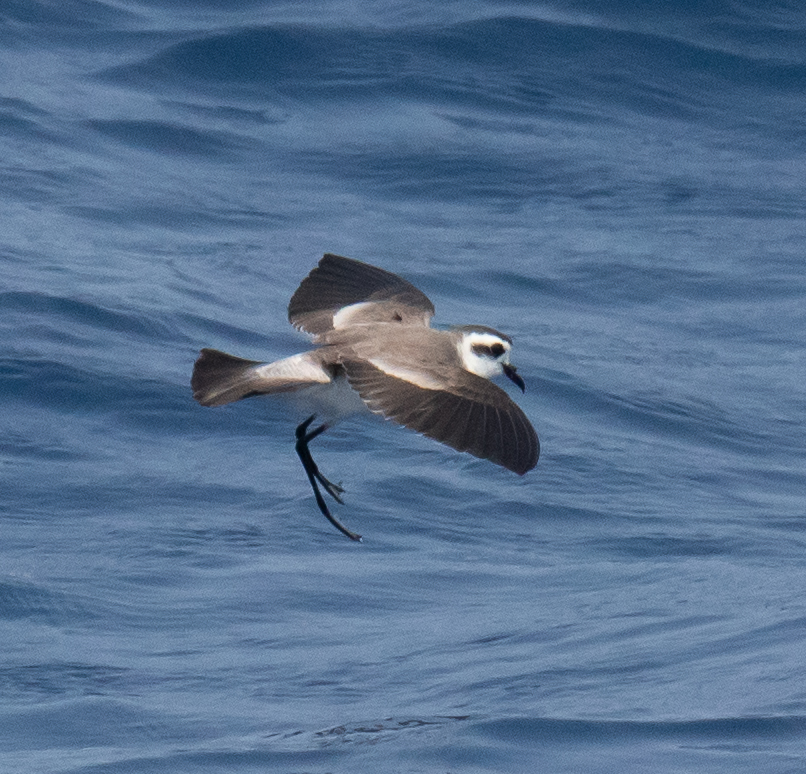
In the afternoon a couple of Leach's Storm-Petrels zipped across the bow and gave us a quick, but identifiable view of this second large storm-petrel species!  A little after 2, we reached the shelf break and picked up speed to head back in toward the inlet.  We were underway when Brian Patteson spotted something off the port bow - a White-faced Storm-Petrel was hopping along right beside us!!!  Wow!  He piloted the boat to keep up with the bird and we were able to keep it in view so that everyone saw it well and we had time to photograph it.  These small birds are not the easiest to capture images of, but we had ample time to get it in our viewfinders and get some in focus shots like these below by leader Ed Corey! 

Since we were only able to get offshore for one day, we were super lucky it was as seabird packed as it was!  Thank you to Alec for garnering so much support for these first summer trips of 2021 and to Ed Corey and Andrew Rapp for helping us to lead the trip!

Species List for July 31, 2021
Black-capped Petrel - 23 to 25
Cory's Shearwater - 5
Scopoli's Shearwater - 37
Cory's / Scopoli's Shearwater - 37
Great Shearwater - 17
Audubon's Shearwater - 18 to 19
Wilson's Storm-Petrel - 220 to 250
Leach's Storm-Petrel - 2 to 3
Band-rumped Storm-Petrel - 5 
White-faced Storm-Petrel - 1
Red-necked Phalarope - 5
Sooty Tern - 1
Sooty / Bridled Tern - 3
Royal Tern - 1
Whimbrel - 1
Semipalmated Sandpiper - 1
Semipalmated Plover - 1
shorebird sp - 3
peep sp - 1
Bottlenose Dolphin (offshore type) - about 40
Atlantic Spotted Dolphin - 6
green darner - 1
wandering glider - 1

Another angle on the White-faced Stormie (Kate Sutherland)
Another Black-capped Petrel image by Ed Corey showing the diagnostic white uppertail that makes them easy to identify at a distance.
We only saw a handful of true Cory's out there, most of the individuals we encountered were either Scopoli's or we didn't see well enough to tell.  Here is one of the Cory's we saw! (Kate Sutherland)
We had some very nicely marked Scopoli's Shearwaters and everyone aboard got to practice identifying these smaller, Mediterranean nesters!  Here is a nice image of one with a lot of white in p10, the diagnostic characteristic of the species.  (Kate Sutherland) A head on view below by Ed Corey showing the small head.
While we didn't see very many Great Shearwaters, the ones we did see came in well to the slick.  (Kate Sutherland)
Audubon's Shearwaters were also very obliging!  These small black and white shearwaters can sometimes be difficult to see well offshore.  (Kate Sutherland)
Wilson's Storm-Petrel showing off its long legs! (Kate Sutherland)
Band-rumped Storm-Petrel sitting on the water (Kate Sutherland)
A couple views of the cooperative Bottlenose Dolphins we found out there!  They are always smiling :) (Kate Sutherland)
We found a little school of Mahi mahi and harvested a few for dinner.  While Andrew was helping everyone with that, I dipped some sargassum for us to sort through for critters.  We found a Sargassum Crab (Portunus sayi) and a number of shrimp, the species pictured below is the brown grass shrimp (Leander tenuicornis).  A huge thank you to participant Alex Huryn for contributing these photos!